
The First Snowfall in Reno
Could I dredge out the muscle memory to paint a simple landscape?

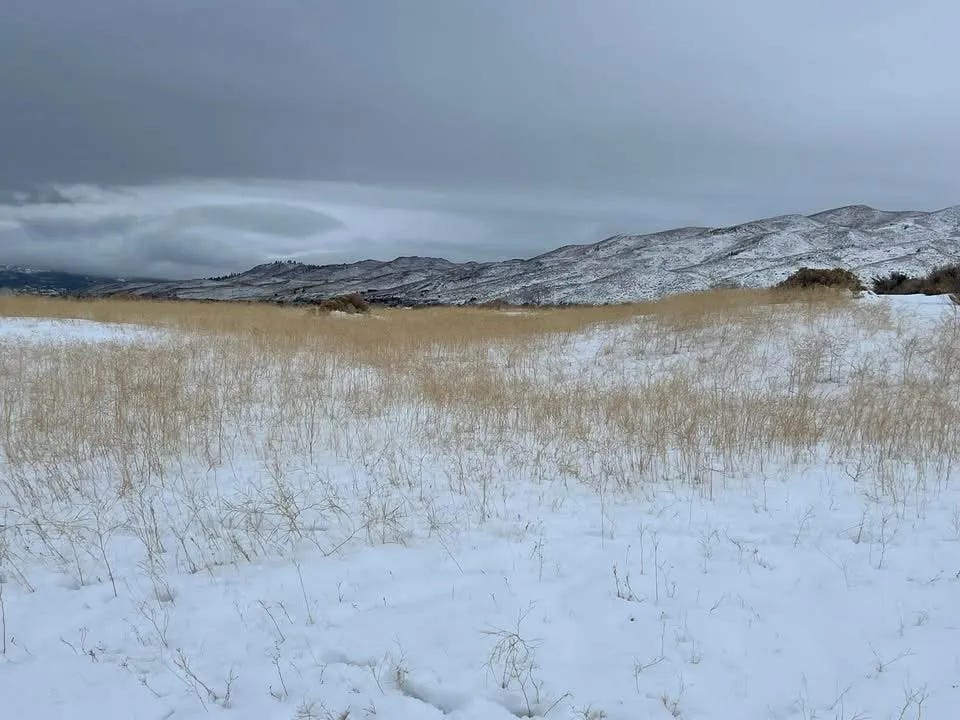
When I first saw the above photo, posted by Mel Minarik, I thought it would make a beautiful watercolor painting. The artist would first lay down washes of Paine’s grey or cobalt blue for the steel-grey sky. Subtle clouds are dabbed to form blurred edges. Then soft yellow ochre washes lay the foundation for a few quick strokes emerging from a field of white. As any watercolorist knows, however, there is no such thing as white. That tube of white pigment just sits there, waiting to be tapped over dried paint to simulate snow flakes or water droplets. Artists usually leave the paper bare in snowy scenes. Then it is tempered with shades of icy transparent blues like cerulean to indicate shadows and contours. Even the stark white wall of an adobe church is mellowed with warmer blues, like manganese blue, to counteract the glare of sunlight. It gives the flat wall a more realistic affect. A transparent pigment allows the white of the paper to show through while a granular pigment shows intriguing gradients for skies and shadows.
After the foundation is completed, the details are set in place. That close horizon appears with the addition of trees and a building to the right. To hint at the evergreen color, a mixture of cobalt and deep cadmium yellow brings out their dour spirit. Cerulean mixed with a touch of burnt sienna defines the mountains in the background. It’s important in both these washes not to create muddy colors. They would create a hole in the composition that could capture and hold the viewer’s eye.
Of course, these colors wouldn’t copy the photo’s colors accurately. The fluid nature of watercolors, with its cool or warm hues and grainy or transparent textures stimulate the eye and opens up a vitality in the scene that the naked eye doesn’t see. It’s why watercolors satisfies me more than looking at oils or any other medium. The unpredictability of watercolors tantalizes and teases as it exaggerates the dynamics of color.
The composition of Mel’s photo defies rules in a way by placing a dominant shape of trees and a building far to the right. Looking at this photo, though, the eye is drawn to the intensified tawny V-shape of grass under the horizon of dark green. Scanning around the photo, the viewer still comes back to that V, the perfect off-center position for a focal point. Using ochre or sienna, the grass glows against the cooler pigments in the mountains and sky. This contrast pulls us into that glow.
Mel Minarik is a retired professor from UNR who lives in Reno, NV. She’s not a professional photographer, but takes photos during her outings in wild spaces that ring this otherwise garish casino city. If one drives toward town at night, the gambling corridor appears in the distance like the Emerald City from the Wizard of Oz. Indeed, it does mesmerize visitors who land there after hours of driving across the desert or Sierra Nevada. Most visitors, however, rarely experience the restful beauty of the Great Basin landscapes around the city. Mel has captured this beauty after our first snowstorm last week. Basin winters become quite bleak compared to the green season of California winters. Mel has blessed us with a reminder that those muted desert hues relax our eyes and spirits. The breath exhales with a long sigh of release.
I posted Mel’s photo online two weeks ago, and Sharron Bassano of Leaves challenged me to produce a watercolor of the photo I spent an entire post describing. Okay, Sharron, here it is:
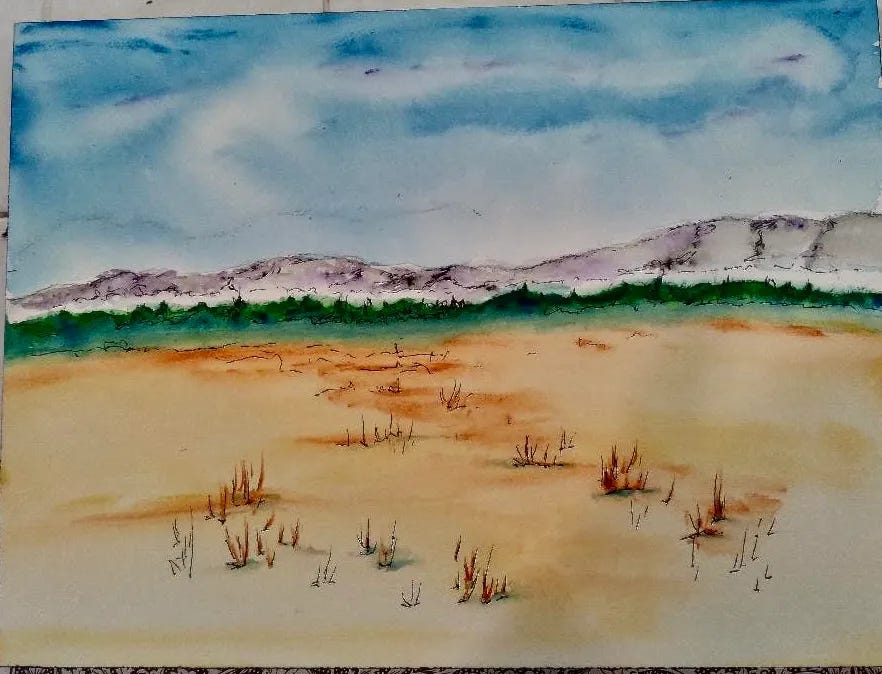
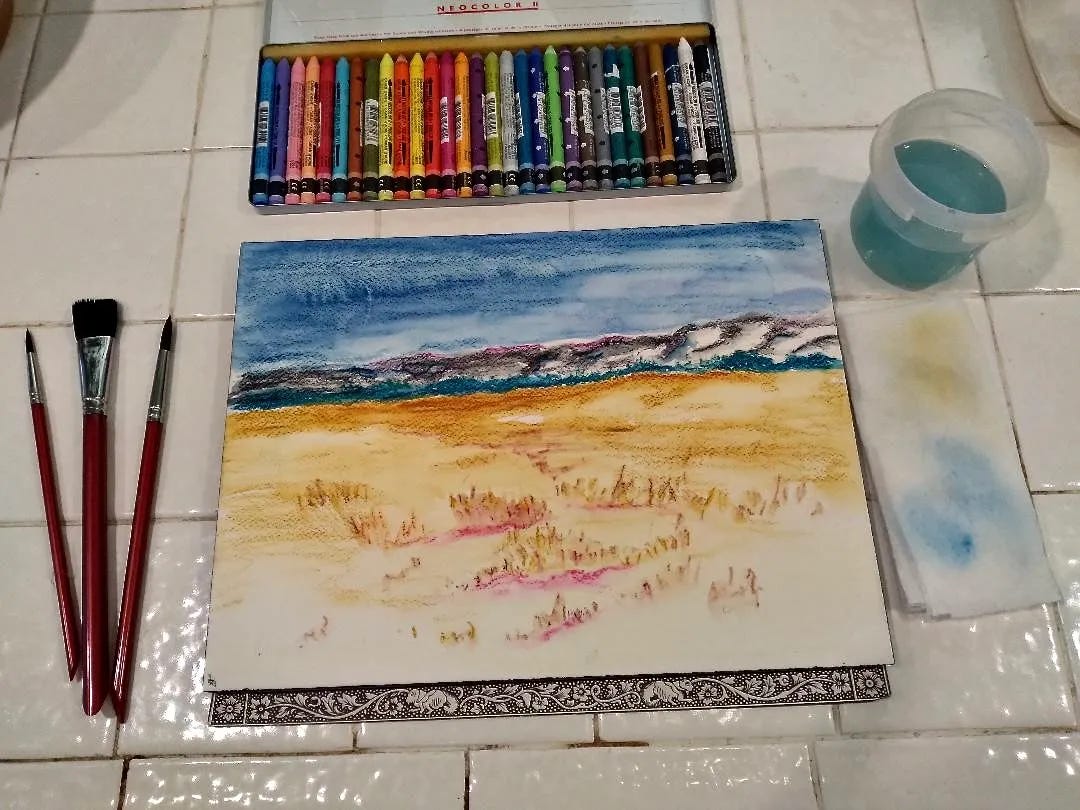
Actually, there are two attempts at painting Mel’s lovely photo of a first snowfall scene in her Reno, NV neighborhood. The first one is done with watercolor crayons. The other, above, is a full-on from-the-tube watercolor pigments.
It’s been well over twenty years since I painted with watercolors. After down-sizing and a move from Truckee, CA, where I learned to paint from Madeline Bohanon, I had pared most of my various hobby supplies. As I searched through the well-organized debris that is my back bedroom, I found pencils and pens, crayons, and paper blocks. To my dismay, however, I had sent a lot of art stuff to … where?
Why would I save watercolor paper and not the tools? I had a favorite two-inch brush with smooth bristles that could sweep a generous wash of water across the paper yet still dab a bit of pigment here and there accurately. Washes exhilarated me with their spread across the page in lovely textures. If anything got out of control, I could daub or swipe with my favorite sponge. Its fine texture and knobby shape mopped up the offending hues. Both of those tools were a blast to use and made this often scary medium just plain fun. Madness must have set in to allow me to give them away.
At first, Sharron’s challenge flummoxed me. I had to replace the paints and brushes, but I didn’t want to invest too dearly in quality materials yet. Also, my little rural town is an hour’s drive to the art stores of Reno … a trip I didn’t want to take. So, I trekked to Walmart and found the basics, such as they were. sigh. Even with all the necessities in tow, trepidation loomed large. Could I dredge out enough muscle memory and brain to paint a simple landscape?
Taking a deep breath, I started with the crayons because, well, I was just too scared to surrender to the independent nature of tube pigments. With a crayon, I could draw the painting and use the side of it to mimic washes. Once that was done, I dragged a brush full of water over it all to bring out a fluid appearance. I used this medium for the painting I posted to head my Substack page. It worked better than I expected.
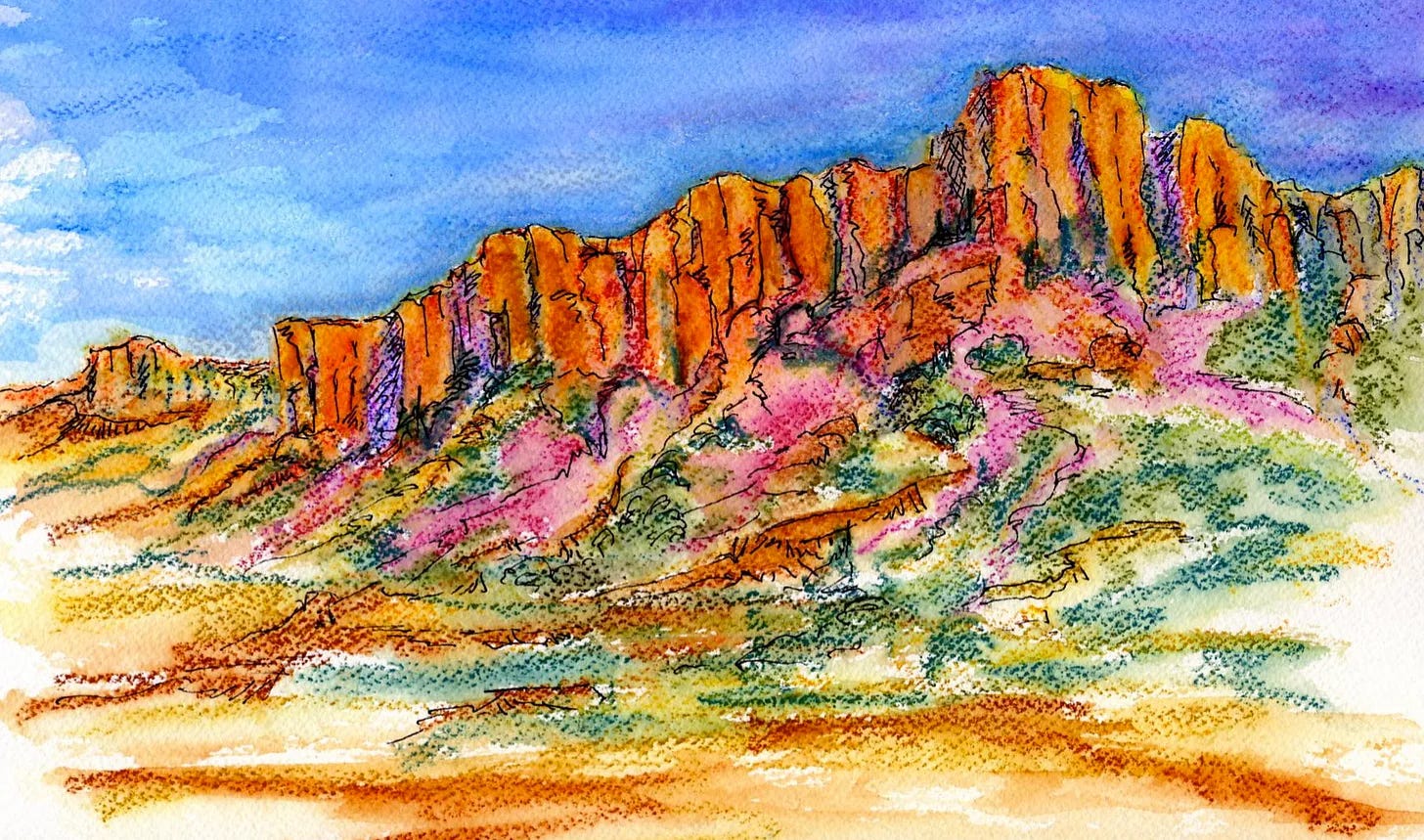
In Madeline Bohanon’s workshops, she would set up a full sheet of paper on her easel, Then with seemingly wild abandon, she would paint a scene, using only her own two-inch brush. She could add fine lines of detail with the brush’s corners. Watching her performance gave us permission to loosen up and go with the flow! I thoroughly enjoyed myself. Now, with new materials, I set up a small “studio” on the kitchen counter and took a long breath.\
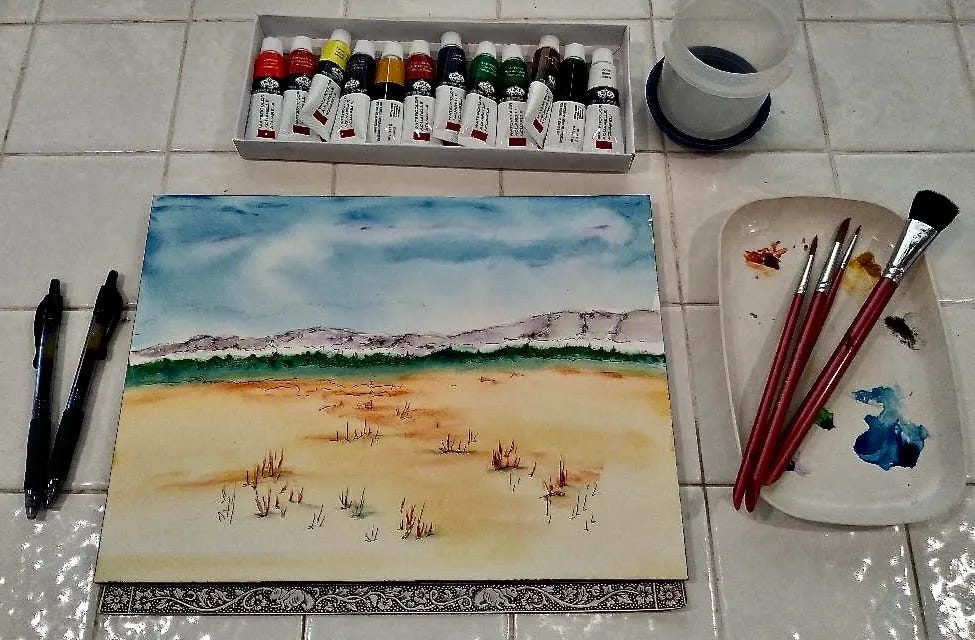
Twenty years ago, my paintings were on quarter sheets, 14 by 16 as I recall. With a block of 20# 9 by 12 inch paper, my former wildness was curtailed a tad. Still, as I applied my newly-purchased paints with a one-inch brush, that wee bit of thrill returned as I watched Prussian blue wander across the damp paper.
MERCY! WHY WAS I SO AFRAID!
Even in this tiny space, I felt the old skills returnign. Granted, I never was a good painter. Sometimes my work was such a disaster, mentors gaped in speechless horror. How do I tell her it’s shit!
Today’s expectations were too high, though. All I needed to do was breathe, get over myself, and start painting. And it was a blast, just like in the past.
One thing I’m experiencing these days is that blowing the dust off old skills brings a rush of confidence. Hey, I can still do this stuff. While I struggle with the piano, sometimes taking it out on my poor instrument, my fingers can recall techniques I practiced sixty years ago. When I relax and just play a tune, putting aside the perfectionism, I feel a buzz under the sternum.
Now I can add watercolor painting back into my list of marvelous ways to spend my days. It’s one of the rewards of growing old and having time to concentrate on old pastimes. We worked so hard as children to learn these things. It’s a worthy endeavor to reclaim them.
LINKS:
Madeline Bohannon died in 2010 at the age of 91 in Tahoe City, CA She mentored countless artists throughout her life and started North Tahoe Arts.
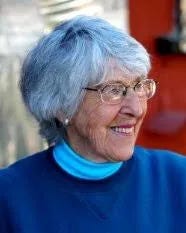
photo by Lisa Korb, Moonshine Ink.
Sharron Bassano, Leaves
Read more from Sue Cauhape on her page, “Ring Around the Basin”:

If you enjoyed this post, hit the ♡ to let us know.
If it gave you any thoughts, please leave a comment.
If you think others would enjoy it, hit re-stack or share:
If you’d like to read more:
And if you’d like to help create more Juke, upgrade to a paid subscription (same button above). Otherwise, you can always help with a one-time donation via Paypal or Venmo.
I love how you put these together ... in a continuous way. Thank you for posting this.
Sue, I absolutely love this piece and it’s more germane to my day-to-day now than you might imagine.
First off, I love the photos and the painting that you did.
Second, this is exactly where I’m at. We took a low level painting class at the Art Students’ League last winter and:
1. I have a new and profound respect for painting. Not that I did not beforehand, but it has increased manyfold.
2. I now see things and think of how I would layer the paint on. Tonya and I have short and serious discussions about under and overpainting.
3. We’re on the road and brought a small watercolor set and your piece could be the thing that gets me to go out today and finally start using it.
Thanks again! I love this.
P