
What the Paint Remembers
Terry Ekasala created the studio. The studio created the work. The work creates something in you that wasn't there before...

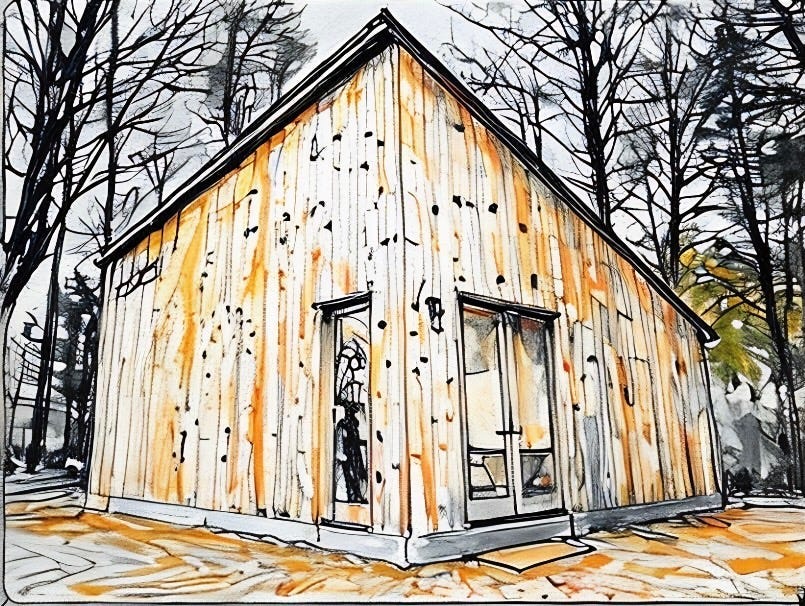
Begin with the table.
Not with the artist, not with the prizes or the Brussels gallery or the Whitney curator who found the words — begin with the table, because the table is the truth of it. A long surface in a studio in East Burke, Vermont, holding forty years of daily devotion in the form of paint-encrusted tins, brushes at every stage of ruin and usefulness, tubes squeezed to their last honest inch, rags that have absorbed more thinking than most libraries, small ceramic bowls wearing yesterday’s color and today’s. It is not a pretty table. It is better than that. It is a table that has been used, every day, without apology, in the service of something that matters.
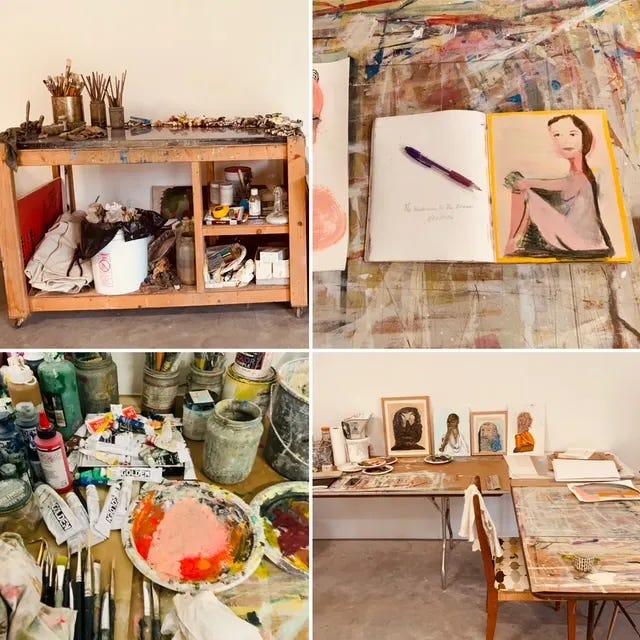
Terry Ekasala created the studio herself…
Designed it, raised it with a group of amazing artisans and builders who made every decision that went into the bones of it — the light, the sight lines, the way Burke Mountain fills the window in a way that is neither distraction nor decoration but simply the world reminding you it’s still out there while you’re in here doing the necessary thing. This is the studio she spent her whole creative life working toward. Not the studio she found. The one she built, because the work demanded a space equal to it and she was not the kind of person to wait.
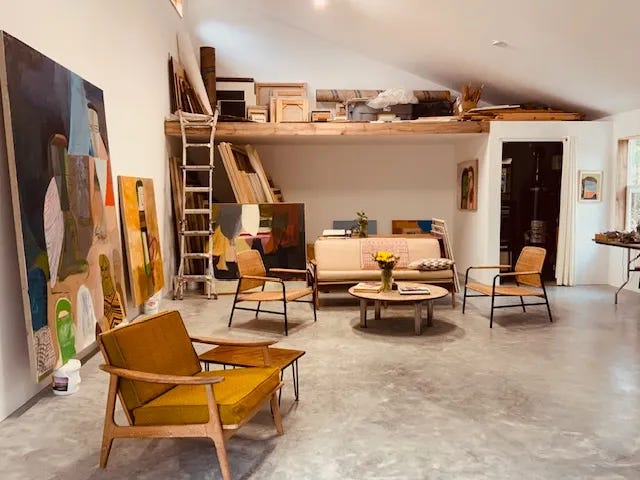
That tells you something essential before a single painting comes into view.
Rainer Maria Rilke wrote that works of art are of an infinite loneliness — that only love can grasp and hold and be just toward them. Terry Ekasala’s paintings know this. They are not paintings that come to you. You go to them, and you go slowly, and you go with everything you have, and even then they do not fully open. What they do is stranger and better than that…
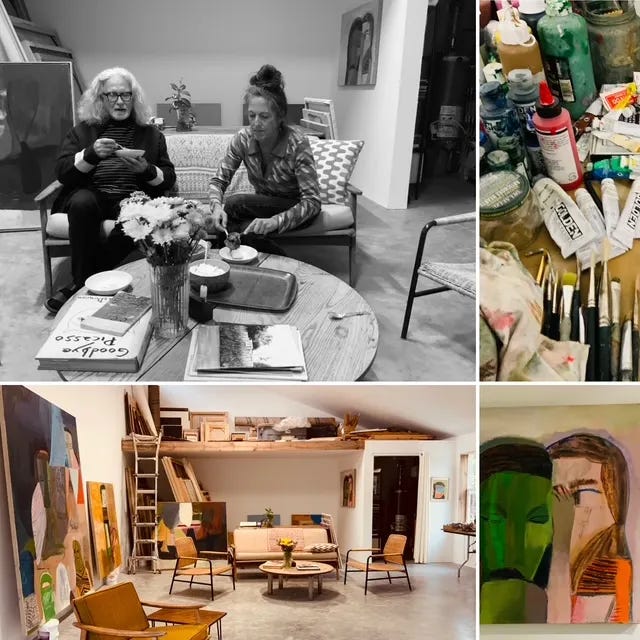
Stand in front of one long enough and you become almost certain you see something — a figure crossing a room, light falling through a window, a woman’s back, a bird in arrested flight — and then the paint asserts its own authority and the image recedes back into color and gesture and you are left in a state that is less confusion than revelation. It is the feeling of remembering something you cannot be certain you experienced.
Recognition without origin.
Chrissie Isles of the Whitney Museum calls it work suspended somewhere between abstract composition and storytelling, creating interior, psychological spaces evoking memory and place — which is precise and true, though it doesn’t quite capture the particular loneliness of standing in front of one of these paintings and understanding that it knows something about you that you haven’t told it.
She works in oils on linen — canvases she builds by hand, stretchers and all, sometimes up to seventy-two by eighty-four inches. She also works daily in acrylics on paper, faster and more immediate, a different conversation running parallel. Both practices feed each other. Both are unmistakably hers. She brings to neither of them a plan.
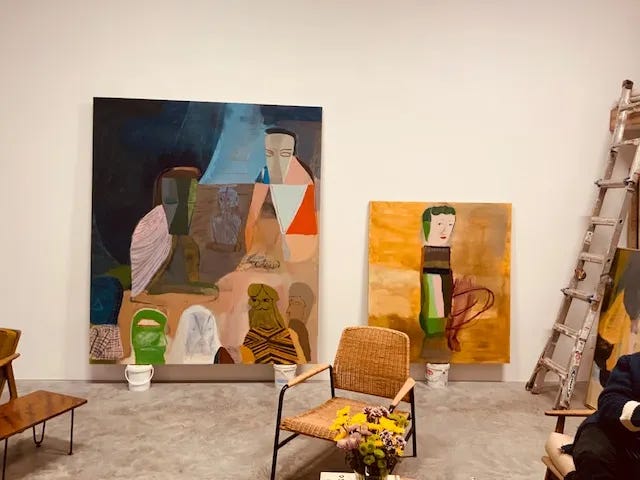
“Letting go and allowing intuition to take over is when the best work happens.”
This is not a philosophy.
It is a daily practice requiring a quality of courage that most people never locate in themselves, because most people cannot tolerate not knowing what they’re making until it’s made. Terry Ekasala has structured her entire life around that tolerance. It is the central fact of who she is.
She was born in Weymouth, Massachusetts. Studied at the Art Institute of Fort Lauderdale. Set up her first studio in 1983 at the Clay Hotel on Española Way in Miami Beach — a broken-down palace of art deco dreams, in her own perfect words — and ran with a crew of graffiti artists whose work on abandoned buildings made the Miami Herald and turned up as backdrops in national advertising campaigns. She was part of the Artifacts Art Group, staging events weekly at Fire and Ice. This was Miami in the early eighties: electric, dangerous, before money arrived and decided what everything was worth.
In 1987 she moved to Paris. Settled in Belleville — the marvelous, ungovernable Twentieth Arrondissement — and found a studio at La Forge, where she became part of a community that organized the first artist squat in the city to achieve legal status. She exhibited in Paris, in Berlin, in New York. She moved from figurative to abstract. She found, in the long slow work of those years, what was actually hers.
Agnes Martin left New York for the desert and spent decades alone making paintings of almost unbearable quietude, and she said that the goal of life is happiness — meaning not ease, not comfort, but the radical, costly thing of becoming entirely oneself. In 2001, Terry Ekasala moved to Vermont’s Northeast Kingdom. She will tell you, with a particular lightness that is itself a kind of eloquence, that it was a whim.
She has not left.
The studio went up.
The table filled.
The mountain fills the window every morning.
In 2023 she was named winner of the Vermont Prize. Her work has shown at Catamount Arts, at Momenta Art in Brooklyn, at PIERMARQ in Sydney, at Metalstone Gallery in New York, at the Schonfeld Gallery in Brussels, where a solo show earlier this year drew the kind of serious, sustained attention that tends to travel. The critic Alex Weinstein placed her in conversation with Joan Mitchell, de Kooning, Diebenkorn — and described her as a heart that beats furiously, keeping painting alive not just for herself but for everyone who encounters the work and finds it authentic, rigorous, fierce.
Francis Bacon said the job of the artist is always to deepen the mystery. Terry Ekasala has spent forty years refusing resolution. The paintings stay open. They stay difficult. They insist on remaining alive.

My husband Joe and I arrived at half past noon with the intention of a studio visit. We left at seven thirty in the evening, and neither of us had noticed the hours going.
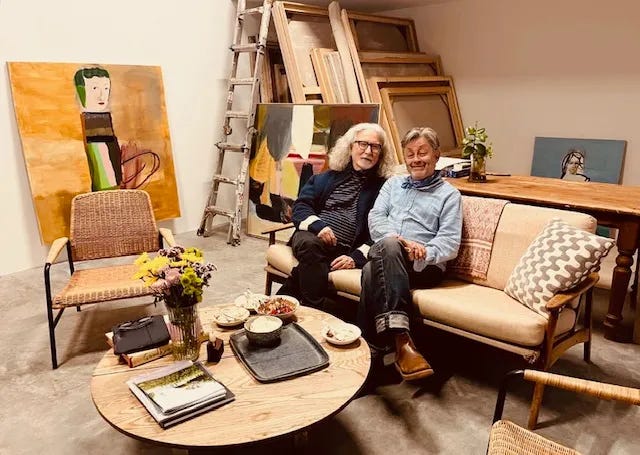
That is the thing I most want you to understand about Terry Ekasala.
There are people in whose company time reorganizes itself — not because they perform for you or dazzle you or work to keep you there, but because something genuine is happening and genuine things have their own gravity. The afternoon moved the way only certain afternoons move: lunch appeared, conversation went where it wanted without asking permission, deep without warning, hilarious when it needed to be, quiet when it needed to be quiet. We talked about cities that made us. About Paris. About New York. About the specific texture of a life given to art before anyone confirmed it was a reasonable idea. About what you carry from one chapter into the next and what you are, finally, glad to set down.
Seven hours. The light came through the studio in the afternoon way and then in the early evening way and then Burke Mountain went that particular gold it goes in April and still none of us moved toward the door. We felt like old friends who had simply been out of touch — people with whole shared histories who had somehow lost the thread and were now, gratefully, finding it again over a table with food on it and a mountain in the window.
This is a quality I have encountered rarely in a life not short on interesting people. It belongs, I think, to those who have spent years practicing radical honesty — on a canvas, in a life, at a table. A person who shows up every day and tells the truth in paint cannot help but bring that same quality of presence to everything else. It is not a technique. It is what you become.
What she made us feel, without trying, was seen.
We drove home through the Kingdom,I kept thinking about the afternoon, the food, the conversation, the secrets shared. The art.
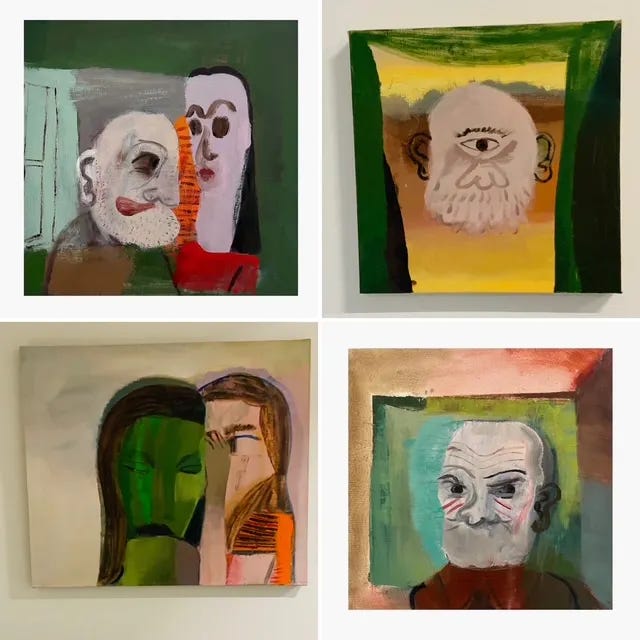
The studio she designed and built herself.
The table inside it. The forty years of mornings that table has absorbed. Miami and Belleville and the Northeast Kingdom, the graffiti and the squats and the linen canvases built by hand — all of it, every detour and decision and whim, leading to a studio at the end of a drive in Vermont with Burke Mountain in the window and a table that tells the whole story before she says a word.
She created the studio her work deserved.
Then she went in and made the work deserve it.
That’s the whole thing, really.
That’s what greatness looks like from the inside.
Terry Ekasala · terryekasala.com
Find the work.
Let it find you back.
All Words and Images by M. Sebastian Araujo (except where noted).
Read more from The Magpie Chronicles…
The Magpie Chronicles is written by M Sebastian Araujo from a handbuilt house deep in an old growth forest, where the winters are long and the opinions are longer.
The Magpie Chronicles arrives when it has something worth saying — antiques, art, history, the occasional miracle, and whatever the world is doing at the moment. If something here found you, subscribe. The basket is always full.
Discover more from M Sebastian Araujo and subscribe here…
If you enjoyed this post, hit the ♡ to let us know.
If it gave you any thoughts, please leave a comment.
If you think others would enjoy it, hit re-stack or share:
If you’d like to read more:
And if you’d like to help create more Juke, upgrade to a paid subscription (same button above). Otherwise, you can always help with a one-time donation via Paypal or Venmo.
 | A guest post by
|
Oh what a life in and with art. thank you for bringing us into her world, and in so doing, opening ours.
What a beautiful piece of writing. Thank you for walking us into Terry Ekasala's world.