
The Small Theology of Edwin Fairleigh
The half smile that followed held its shape as he showed it, another crease to be maintained...

Fuck. Motherfucker. Pussy. Shit. He said those easily, almost lightly, as if demonstrating something that did not cost him. The words that offended him were smaller. Nice. Nice is not a nice word, I remember him saying. Pretty. Boss. Goddamn. Those four he treated as a kind of blasphemy. Goddamn was especially ironic, because he was a nonbeliever. When he reached for his fountain pen, slipping it from the inside pocket of his jacket, I realized I hadn’t actually heard him say those words. Instead, he wrote each one, separately, on the paper napkin between us, as if they needed to be kept at a distance. By the time he capped the fountain pen and slid it back into his pocket, a dark halo had already begun to spread around each word. The napkin too thin to keep the ink from wandering. When he set his right hand on the table again, a smear of blue showed on the side of his index finger, caught just above the nail. As if the words refused to stay entirely on the paper. The napkin, with his forbidden words, lay between us. The edges softening where the ink had bled.
Just hearing other people use them, I remember him saying, felt improper, like someone dragging a chair across a floor he’d just finished polishing.
Edwin had turned into a man worn smooth by deliberate living. As he went on about himself, I felt both charmed and a little exhausted. He spoke about his work the way one might describe the upkeep of a church—careful, reverent, almost without complaint. I confess, however, that my focus was less on what he was saying and more on how he handled himself. His clothes were unremarkable in cut but immaculate in care. The collar of his shirt held a hard crease. The buttons gleamed a bit, not from cost but from attention. There was something in him that leaned towards old-fashioned.
“He’s old-fashioned,” Michael and Louise would have said, friends from grade school, if I’d told them about him later.
He removed his leather gloves before he shook my hand. The gloves were brown. Though I might be giving them that color now. He loosened each finger first, pinching lightly at the tips until the leather gave, then drew the glove away in one smooth pull. Even the act of undressing his hands required a ritual.
When he set the gloves on the table, I noticed the left glove had a small tear near the thumb. He positioned them so the tear faced away from me. Later, when I glanced down, he’d rotated them back. The tear was visible again.
His first cup of coffee sat untouched for a time. When the steam from his cup reached across and braided itself with mine, I tried thinking of our bodies doing the same—but couldn’t. Not yet. Something in the way he held himself refused the image. His first sip—measured, deliberate—suggested years of training himself out of indulgence. After each sip, Edwin set the cup down in the same position every time.
When the waitress asked how everything was, he answered properly, and that word struck me. Not as praise. As compliance. Not delight, but order. He lifted his cup as though to make a point about moderation itself. His wrist had aged just so, the skin drawn a little fine over the bone, and I thought again of the napkin words, the small theology he lived by.
He smiled once, ever so faintly, when I mentioned how some people mistake attentiveness for virtue. His fingers brushed the rim of his cup, the motion steady enough to make me restless, leaving me to think that his restraint had begun to press on the air between us. The kind that asked to be broken, though not by him.
I wondered if he ever allowed anything to spill. I wondered if his bathroom mirror showed droplets on the glass. I wondered if he wiped them away before they could settle. My ex-boyfriend used to leave wet towels on the bathroom floor, toothpaste uncapped, cabinet doors hanging open. I’d found it maddening then. He also used to wake me up at 3 a.m. to show me videos of sea otters holding hands, convinced I needed to see them immediately. I’d loved that. Now, sitting across from Edwin, I wasn’t sure which kind of person I actually wanted to be near. I wondered if there was a life beneath that polish and if I would be capable of sharing it with him.
He asked a question, something forgettable, but his voice carried the same precision as his gestures, and I felt, absurdly, that he was measuring me for inclusion in his order of things. His body remained still when he spoke. Only his mouth moved, as if the rest of him held in reserve. Slowly—I think; it’s been so long now—I almost found myself mirroring him. I remember sitting straighter than I normally would. Lowering my voice. Measuring my words against his quiet. Not once did he cut across my sentences; listening, he let each one of my words compose each sentence and allowed each sentence to come to rest before he answered. After a while, I found myself doing the same, as if overlapping were a kind of impropriety. It’s a lesson I still uphold, without quite meaning to.
And I remember the restaurant transforming into a room that seemed to follow his pace. The clatter from the bar and the dishes and the glasses dimmed to background. Even the large clock above the door sounded patient. As though that old clock recognized Edwin and had agreed to slow its hour hand and its minute hand, to wait along with him.
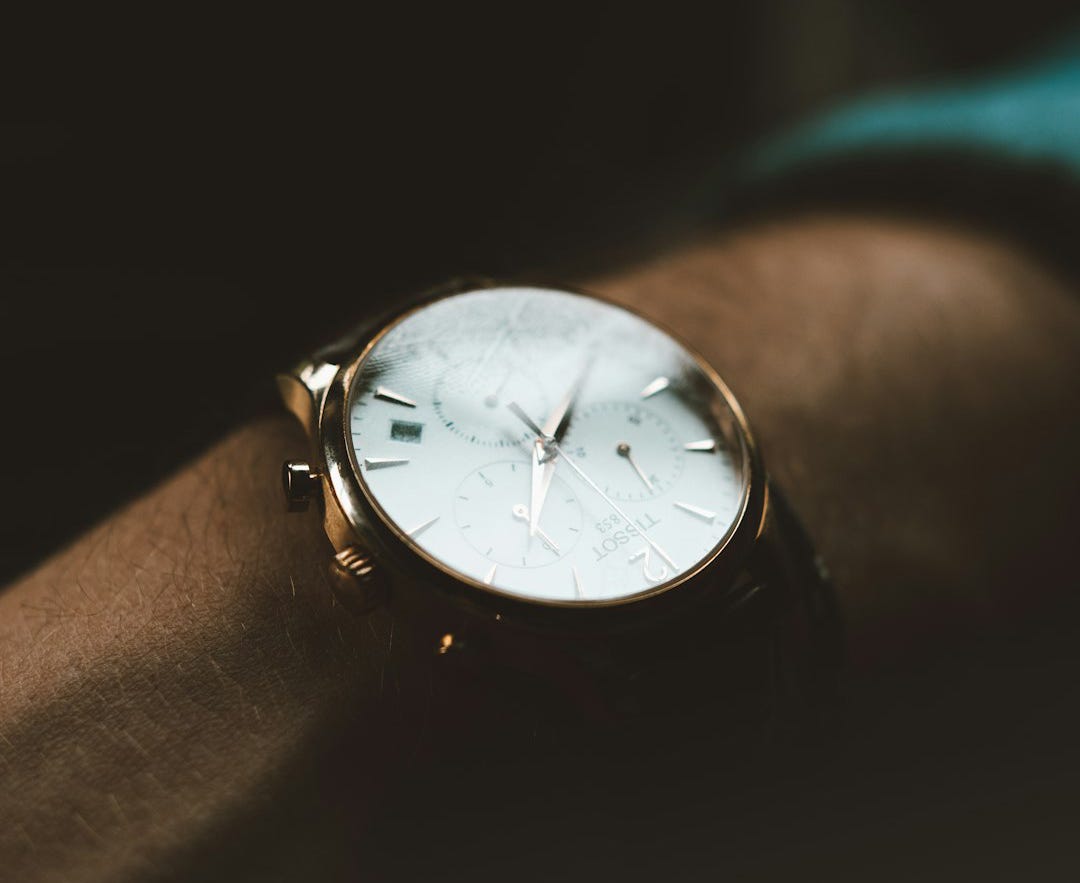
The story Edwin told about repairing a watch his father had owned sounded like a confession. Every spring and pin of that watch had to align before the hands would circle true. Edwin’s eyes stayed on the table. When he described the moment the hands finally moved again, his voice changed—not lifted, but flattened, as if reciting something he’d practiced. But I saw something in his face. Pride, maybe, or relief.
“My father never wore it,” he said. “Not once that I saw. Kept it in a drawer. I’ve worn it every day since.”
He looked down at the watch on his wrist, then up at me, as if waiting for something. I didn’t know what.
The moment stretched too long before his eyes dropped back to the wristwatch and then the table. His thumb rested on the folded napkin where those four forbidden words bled through. Maybe he had been reminded of something.
The distance between us, across the table, became a thing I could feel. It lifted the hairs on my arm the way the air does before a storm. Instead, he seemed immune to it, or maybe worse, devoted to pretending immunity.
When he looked at me, I don’t think it was longing he felt. Evaluation instead. What unsettled me was how intimate it felt to be assessed. As if he were undressing me. As though he could see how I’d held myself since arriving—the straightness of my spine, the stillness I’d been performing. As though he could see the care I’d taken—the pressed shirt, the cologne I’d second-guessed in the bathroom, looking in the mirror, an hour earlier, wondering if it would be too much or not enough. Small acts of preparation that now felt obvious. I had the sense he was measuring not the effort but how much softness he could allow himself to see.
His attention shifted to the spoon on his side of the table, which he aligned so it lay parallel to the knife. I remember him looking at my spoon but not reaching for it. Then he moved his cup half an inch closer to the saucer, as if the distance had bothered him from the start and only now became intolerable—or he felt comfortable enough for such liberties. Watching his fingers, the small, exact corrections they made, it occurred to me that he might do this everywhere: hotel rooms, office desks, even the ledge of a stranger’s window if allowed close enough.
It was then that I realized I’d stopped eating entirely. My fork lay where I’d set it down minutes—or was it longer?—ago. I picked it up and deliberately set it at an angle across my plate. Not parallel. Not perpendicular. Just wrong. The silence between us felt different then—less like patience.
He didn’t look at it. Didn’t say anything. But I felt the wrongness of it between us—the angle, the disorder I’d purposely introduced. The silence stretched. And as it continued, I let out a deep breath. Surrendering. I reached down and adjusted the fork myself. Parallel to the knife. He still didn’t look at it. Didn’t acknowledge what I’d done. But something in his posture softened, just barely, as if he’d won a battle I didn’t think was worth fighting. Or maybe I’d just answered a question he hadn’t asked.
“Do you ever leave your bed unmade?” I asked, intending it as a joke, hearing the edge in my own voice too late.
His eyes lifted. For a moment, he considered the question as though it required a serious, proportional answer.
“I prefer things finished,” he said. As if he were saying grace. The half smile that followed held its shape as he showed it, another crease to be maintained.
I remember dragging my thumb along the rim of my cup until the coffee tipped and slipped over, forming a dark crescent staining the saucer. It wasn’t much. Hardly a spill at all. A small part of me waited for him to react. He did notice, of course, the way a person might register a sudden change in temperature. But instead of reaching for a napkin, he folded his hands together on the table, as if reminding himself of a lesson learned long ago.
“My father was like you,” I said. Then realized I’d never told him my father was dead. Realized I didn’t know if he was like Edwin at all. Realized I’d just said something true that might not be true.
He took a measured breath, the kind some of us take before lifting something fragile. “It’s…less confusing, actually,” he answered. There was a pause before “less,” but I heard it. I’m certain of it. As if he’d rejected another word before choosing that one. For a moment, I tried to guess what the first word had been. Safer. Necessary.
The napkin with his forbidden words still lay between us, its edges softening where the ink had bled. I reached for it without thinking, my fingers stopping just shy of the paper. That was all it took. The tiniest hesitation. Without pulling the napkin away, he shifted his hands and reclaimed the space around it. His knuckles brushed the corner of my fingers. A quiet reward. Mine, or maybe his.
His gaze remained on my face—attentive and kind enough. The air between our hands warmed; I remember feeling it, the way a room feels different when someone has closed the front door to the outside.
The waitress arrived just then, a soft interruption. Her shift was coming to an end and she asked if we wanted anything else, the way servers do when they’re really asking if it’s time for them to clear the table. Edwin’s hands unfolded neatly. First he looked at me and, after I shook my head, he looked back at her and said, “No, thank you. That was very pleasant.” Pleasant, it seemed to be the word he trusted. The word sounded kind, like he’d been polishing it all along, just waiting for it to come out.
She smiled at him the way women sometimes do when a man is unfailingly polite, with that slight extra warmth given for effort. “I’m glad you liked it,” she said. With his cup now empty, he crumpled the napkin stained with ink, and he put it in the cup. As if he were burying a secret away. Then he reached for a fresh napkin and, carefully, laid it flat over the cup.
“Could we have the bill, when you have a moment?” he added. The phrase was gentle, deferential even. Yet there was an orderliness under it I had already begun to anticipate. The waitress nodded, slid the check under the edge of the napkin, and left us again. I watched his eyes follow her only as far as necessary, no more. What little he may have noticed about her, he kept to himself.
He took out his wallet, without performance, before I could reach for mine.
“Please,” he said. “Allow me.”
The way he separated the bills, smoothing their corners, made the act feel less like generosity than completion. I had a sense he would be just as thorough paying alone. Still, when our fingers met again, over the check this time, there was that same quiet charge as with the napkin. A contact that pretended to be accidental and failed.
When he finally reached for his gloves, resting there beside the cups, I realized I had been waiting to see whether he would slide them on quickly or take his time again. He did neither. He smoothed each finger open first, as if confirming the shape was still there for him to return to, then eased his hands inside. The small ceremony of it made my own bare fingers feel provisional, as though I were the one not yet finished.
He held the door for me. Outside, the air had cooled, the street taking on that late-hour hush when the storefronts are lit but no longer inviting. Without the awkward search for parting phrases, we shook hands again—this time both of us wearing gloves—and agreed, almost lightly, that we would see each other again. The words felt practical, like setting a time for a follow-up appointment. Still, there was a warmth under them, a low current running through the fabric between our palms.
This is the kind of man, I thought then, who is of his word. The thought arrived fully formed, so obvious it didn’t feel like a judgment at all, just a fact I had walked into. When the first week went by without a call, I assumed I had miscounted the days. When the second passed, I decided his carefulness must extend to disappointment; perhaps he believed even refusals should be handled properly, drafted in full before being sent. By the third week, I began to think I had misread him entirely.
It wasn’t until much later—months, in fact—that I saw his name again. An older edition of The Daily Beat lay folded on a plastic chair in a waiting room, the pages gone soft and yellow at the edges. I picked it up without thinking. Near the bottom of the local section, there was a small article about a man collapsing on his way home one evening and dying in the ambulance. No scandal, no drama. Just a brief account of a heart that had stopped between one street and the next.
The photograph was grainy but unmistakable. The tilt of the head, the set of the mouth that tried to look relaxed and never quite managed it. The same bow tie. His name was printed beneath: Edwin Fairleigh.
Or that’s what I remember. I’ve carried this for so long now that I’m no longer certain which parts I read and which parts I needed to be true. The photograph might have been him. Or it might have been someone else—same generation, same formality, same careful way of presenting himself to a camera. I never kept the paper. Never went back to find the issue again.
What I’m certain of: he never called. Three weeks became a month and maybe more. At some point—I don’t know when exactly—I needed him to be dead more than I needed to know what had actually happened. Needed the silence to mean something other than disinterest. Needed his precision to have been interrupted by something final rather than something as small as a change of heart.
The enlarged heart. I’ve told people about that. Edwin’s heart, just too big for his body. But I don’t remember if I read that too or if someone told me or if I invented it because it completed something. It sounds true. I wanted it to be true. It sounds like the kind of detail that would appear in a brief obituary. The kind of medical irony that makes a death feel like it was always waiting to happen.
I never saw a funeral notice. Never called the number he’d given me—it’s possible I threw it away after the second week. It’s possible I never had it at all.
The date on the paper was the same night we’d sat across from each other, his gloves resting between us like a promise he had every intention of keeping. I’m almost certain about that. The timing was too perfect not to be true. But I’ve also needed it to be that night—needed him to have died with the taste of coffee still in his mouth, with the memory of my fingers almost touching his, with plans to call me that he would never complete.
When the phone stayed silent, at some point I stopped waiting and started remembering instead. And memory, I’ve learned, is just another way of finishing things.
Years later, in the same diner, my grandson smeared carrot cake frosting into the groove of his plate while I waited for the refill. He’d been talking about a boy at school—someone who organized the other kids’ desks when they weren’t looking.
“It’s weird,” he said, then went back to the frosting.
The clock above the door had been replaced with a digital one. In the next booth, a young man was telling a girl what a “nice” evening it had been.
I watched him line up the sugar packets, one by one, while she smiled. My palm pressed against the split vinyl of our booth.
Luciano Conte, born in Formia, Italy, roots himself in tactile arts like film photography, painting, bread baking, and house building. He writes in order to probe those persistent, buried forces that shape us from beneath the surface. For him, silence is not absence but presence: a pause that resonates the loudest, like the pause in a conversation that carries more weight than words. He speaks his lines aloud while writing, tying rhythm to breath, making language a living, physical act where sound and sense fuse, just as photography captures light and shadow. He urges readers to read his work aloud to unlock layers that silent reading misses, letting the cadence shape the experience in the same way as kneading dough or laying foundation stones, where each gesture is deliberate and consequential.
If you enjoyed this post, hit the ♡ to let us know.
If it gave you any thoughts, please leave a comment.
If you think others would enjoy it, hit re-stack or share:
If you’d like to read more:
And if you’d like to help create more Juke, upgrade to a paid subscription (same button above). Otherwise, you can always help with a one-time donation via Paypal or Venmo.
 | A guest post by
|
A lovely piece, Luciano. Old world. Finely wrought. A dash of Proust. A pleasure.
"memory....is just another way of finishing things" love that!
beautiful piece of writing, Luciano