
The Nerve of It.
Also a note on Hans Baldung Grien, who received a lock of Albrecht Dürer's own hair, and who earned it…

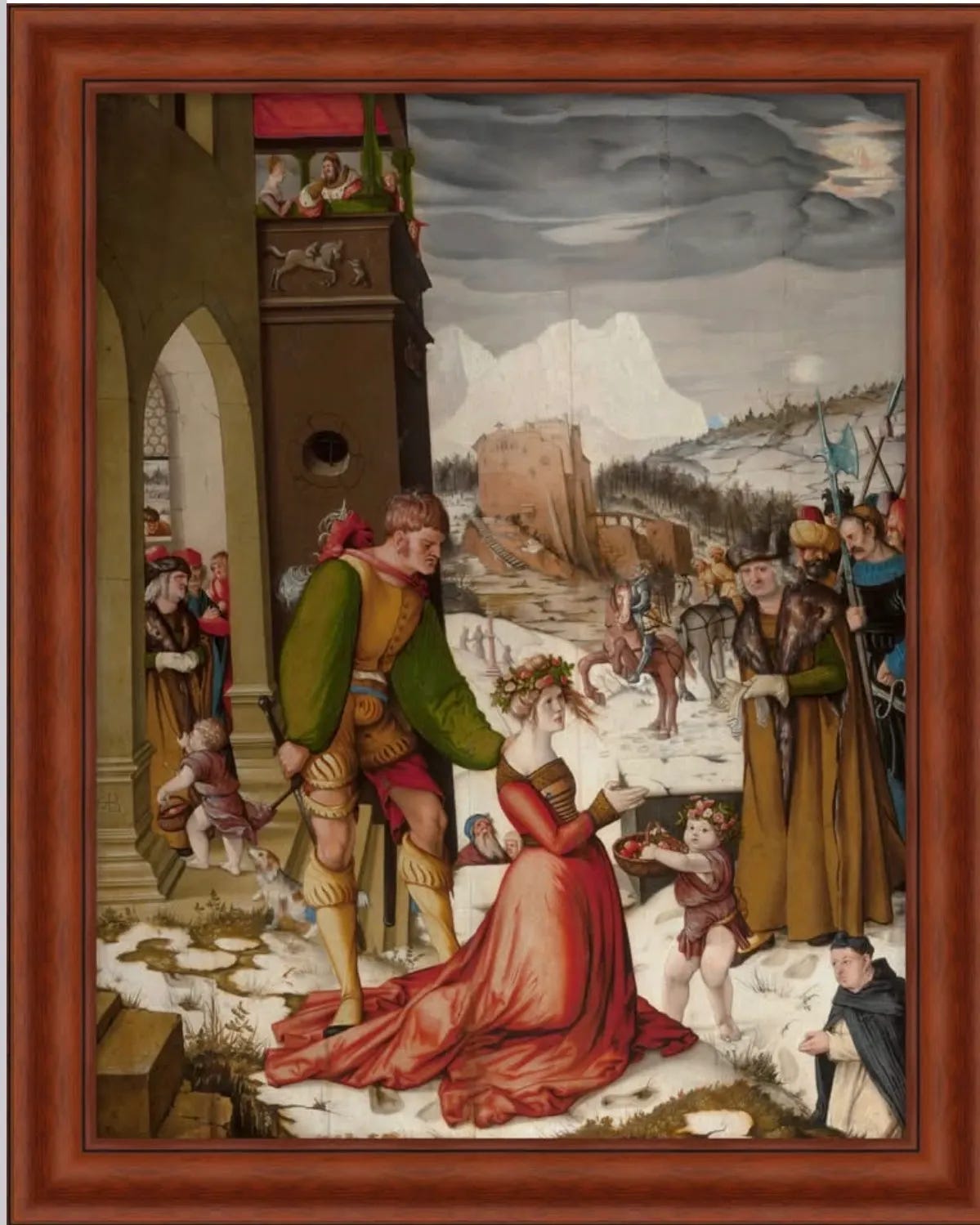
Theophilus was a Roman scribe — a man of documents, of official language, of the bureaucratic machinery of empire — who made a sarcastic remark to a woman on her way to her own beheading, and nobody in the history of public mockery has been more immediately and thoroughly punished for it.
The woman was Dorothea of Caesarea. The remark was: “O Bride of Christ, send me some fruits from your Bridegroom’s garden.”
It was February.
He meant it as a joke. The kind of joke that powerful men make to women who are no longer in a position to answer back — which is to say, the lowest and most reliable form of humor available to the human animal. Theophilus had behind him the full temporal authority of the Diocletian empire, which had been trying to stamp out Christianity with increasing desperation before eventually, exhausted by the project, converting to it entirely. He had every reason to feel secure.
He was not.
Dorothy turned to face him in the crowd — this woman being marched to her execution dressed, by all accounts, like a bride — and she looked at him with what witnesses described as kindness and said, quietly and with complete self-possession: “You and I shall meet together in that garden.”
Theophilus laughed.
The crowd laughed. But earlier, when the governor had offered her marriage or death, Dorothy had already answered in words that left no room for negotiation: “Christ was her only Spouse, and death her desire.” She was not a woman who said things she didn’t mean. Theophilus, being a man who worked in words for a living, should have understood that.
After Dorothy’s beheading — I use the word plainly because she bore it plainly — a child appeared to Theophilus carrying a basket. In the basket: three apples, three roses. In February. In Cappadocia. Theophilus turned to his friends, this educated man, this officer of the empire, and said: “In the winter, Cappadocia is covered with ice and frost, and the trees are bare of leaves. What do you think? From where do these apples and flowers come?”
His friends had no answer.
Neither did he. He confessed his faith in Christ on the spot and was subsequently martyred, which is the universe’s way of making a point it considers important.
I have been thinking about this story for thirty years, and every February it finds me again, and I would probably have kept thinking about it privately and said nothing, except that Hans Baldung Grien painted it in 1516 in a way that makes it impossible to keep to yourself.
The painting hangs in the Národní Galerie in Prague. Go. It is smaller than you expect — roughly the size of a good hotel mirror, which is precisely large enough to make you look at yourself looking at it. Baldung was Albrecht Dürer’s most gifted student, a fact confirmed when, after Dürer’s death, his people sent Baldung a lock of the master’s own hair— which is the most German expression of love and esteem ever recorded, and which Baldung earned, and which this painting proves.
What Baldung understood — what makes this picture live when a thousand other martyrdom paintings are merely dutiful — is that he set the whole thing in SNOW. Heavy, particular, February snow. The kind that has been on the ground long enough to look like it has always been there and intends to stay. And against all that white: Dorothy’s dress. An extraordinary red. The red of a decision that cannot be walked back.
He was not being decorative.
He was being PRECISE. Dorothy’s feast day falls on the sixth of February. In sixteenth-century Germany there was no global supply chain, no truck arriving on a Tuesday morning loaded with strawberries from Chile, no Whole Foods to make miracles routine. There was just winter — which lasted longer than we now remember it ever lasting — and the distant theological promise that things might, eventually, bloom. To find roses and apples when the world outside offers nothing but grey sky and frost-hardened ground was a miracle in the plainest and most physical sense of the word. It would have landed in the body. Like cold air. Like sudden heat.
It still does, if you let it.
Look at the child.
He is painted as a kind of putto — chubby, rose-crowned, bare feet on frozen ground — and the bare feet are the thing I cannot stop thinking about. A child, unshod, standing in snow that would make any living creature flinch, and he is not flinching. He exists in some other relationship to cold and frost and the ordinary cruelty of February than the rest of us do. His expression is the expression of someone who has been asked to deliver a message and intends to deliver it, no more complicated than that, entirely unimpressed by the fact that he should not be possible at all.
And the basket. The apples glow red against all that white and seem, impossibly, warm. The roses are pink in the way that roses in February have no business being pink. The whole thing should not exist and it DOES — the way the child should not be standing barefoot in snow and IS — and the feeling this produces is not wonder exactly and not quite fear but something that lives between them, in the place where the world cracks open just slightly and you see, briefly, that the rules you have been living by were never as fixed as you believed them to be.
In the corner of the painting, tucked away like a footnote, there is a monk. Dark-habited, small, watching the child with the expression of a man whose entire intellectual architecture is being quietly, methodically dismantled by a small barefoot boy with a basket of fruit, and who has not yet decided whether to be grateful for this or to grieve it.
I know that expression.
I have made that expression.
St. Dorothy is the patron saint of gardeners, florists, and newlyweds — a combination that is DEEPLY coherent, if you think about it. All three are in the business of tending things that are fragile and lovely and prone to dying at the wrong moment. All three require a particular faith that what you press into the ground now will, against considerable evidence, come up in the spring. All three know what February does to a person — that it is one thing to believe in gardens in June, when everything is lush and green and practically insisting on itself, and another thing entirely to believe in them when the sky is the color of an old argument and nothing, nothing, looks like it is ever going to bloom again.
And yet
Here is the child with his basket. Here are the apples. Here are the roses — in February, in the snow, in a small painting in Prague that a German made five hundred years ago and that is, if you stand in front of it long enough, still making its argument to anyone with the nerve to receive it.
The miracle was not that the fruit appeared.
The miracle was that Theophilus — pompous, educated, fully armed with the contempt of the powerful — opened his mouth in the cold and ASKED for it. He did not know he was asking. He meant to wound. But the universe is not always interested in what you meant.
Sometimes you ask for the miracle in the very act of declaring it impossible.
Sometimes you get what you asked for.
See more of the work of Hans Baldung Grien here:
Read more from The Magpie Chronicles…
The Magpie Chronicles is written by M Sebastian Araujo from a handbuilt house deep in an old growth forest, where the winters are long and the opinions are longer.
The Magpie Chronicles arrives when it has something worth saying — antiques, art, history, the occasional miracle, and whatever the world is doing at the moment. If something here found you, subscribe. The basket is always full.
Discover more from M Sebastian Araujo and subscribe here…

If you enjoyed this post, hit the ♡ to let us know.
If it gave you any thoughts, please leave a comment.
If you think others would enjoy it, hit re-stack or share:
If you’d like to read more:
And if you’d like to help create more Juke, upgrade to a paid subscription (same button above). Otherwise, you can always help with a one-time donation via Paypal or Venmo.
 | A guest post by
|
Wonderful!
W🍎W