
Sleep
How wonderful it would be to stop thinking...


Such a glorious thing, when it works. When the body behaves the way it’s meant to. The circadian clock winding down into darkness. The blurring of the words on the page you’re reading. The last misheard words of the conversation you lost track of, because you weren’t there anymore. You were somewhere ahead, mind emptied, following the leaf strewn path into your dreams.
It can be easy to sleep. On days when you’re worn down to the bone. On the day you took up racquetball or swimming again, after years. Or you carried boxes of books up and down the stairs. Or, under a strange ceiling, after you followed your guidebook to exhaustion in some foreign place, trailing for miles behind your appetite until your shoes gave out.
Nights when you’ve come home late after a dinner party or the theater, drowsy from the overstimulation of food and conversation, draping your clothes wherever as you fall into the sweet silence of the bedsheets. Those nights when you are asleep before you even land; when the dimness rushes to you like it’s been in love with you, waiting, this whole time.
Those nights are like promises. Like kisses from the heavens. If only you could catch the rhythm, the trick of it. This was how God intended his children to sleep.
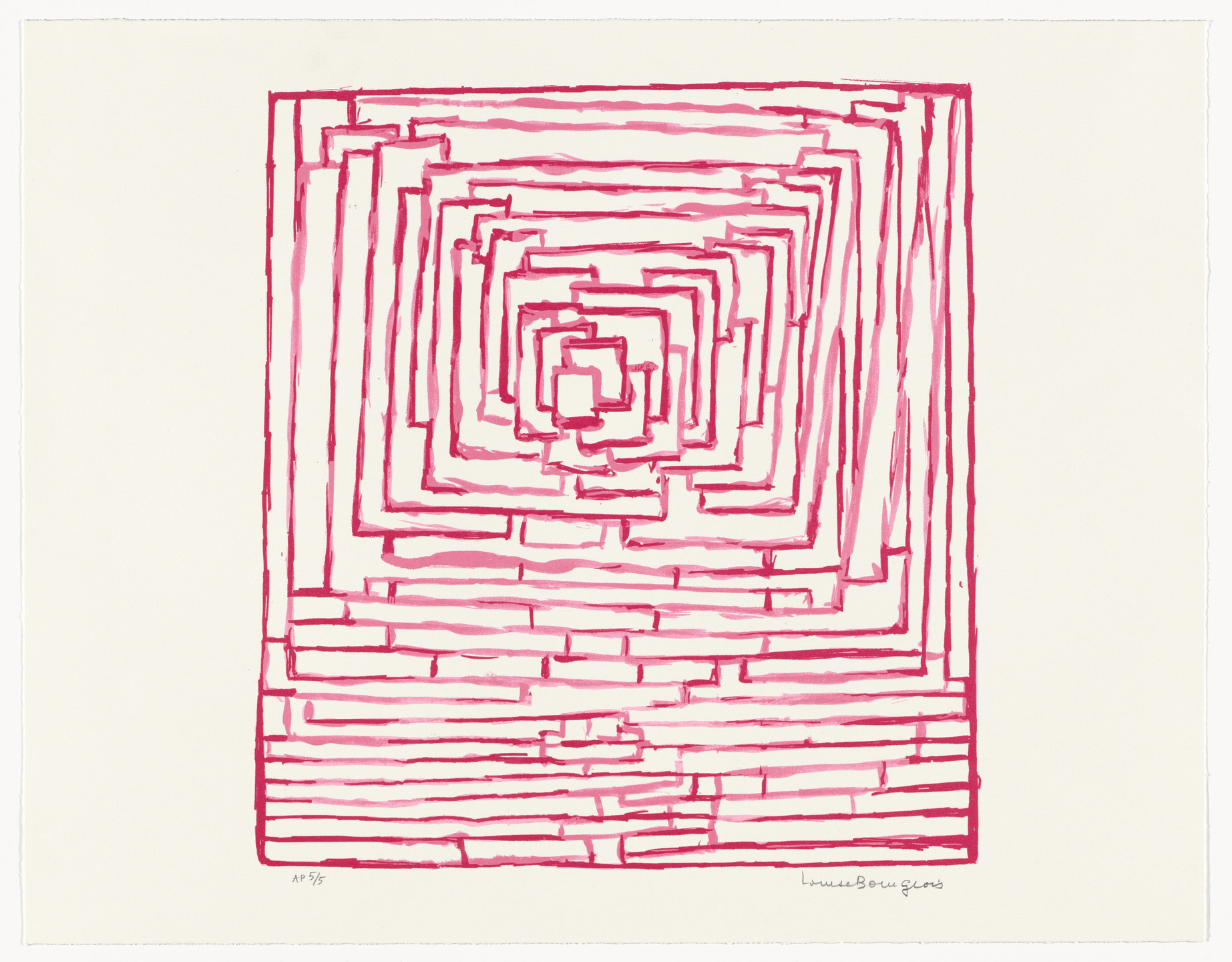
But here I find myself, yet again, at the labyrinth.
I lie awake at midnight, imagining a blue sky. Andy told me to do this. Andy, who is my favorite, with his nice lulling British accent and a slow, precise way of speaking. Of all the voices on the meditation app, Andy is by far the best. He sounds like he hikes on the weekends. And, if he talked about his hiking, he would say “week-end” in that nice, choppy, British way. Andy sounds like he’s read maybe a few too many self-help books, but that makes him more relatable to me, really. He sounds so earnest as he tells me to picture a blue sky and the clouds passing by.
The clouds are my thoughts. This is the key thing I’m learning from him. My thoughts aren’t inside my head. They aren’t digging their fingernails into my brain. They are away from me, in the sky, miles above and harmless. My thoughts are just things that form, Andy says, like clouds form from the water in the air, and then they pass me by.
I don’t like a too-blue sky, though. The empty space behind the clouds. To keep my attention, I begin to furnish the landscape. A green field between myself and the sky. Rows of corn, maybe. A few trees on a hillside, or a road snaking along the horizon. One car in the distance. The car could be a thought passing, just as easily as a cloud could be. It also appears and then it leaves.
Andy never said I needed to fill my sky with these perfect, computer-background-style white and fluffy clouds. He only said clouds. They could just as easily be cirrus clouds, low, gray and thin, my worrying thoughts like clouds of cigarette smoke, with a winter dawn light behind them. Cirrus clouds still pass over, though it’s harder to discern as it happens.
The sky gives me what I need some nights. It takes from me what needs taking on the nights when my thoughts make for good clouds. On other nights, worse nights, the sky flickers out. The air becomes a swarm.
Then, I have more tools.
The word “PILOT,” for instance, begins with ‘P.’ Other words beginning with ‘p’ include “procrastinate, polymorph, pup, pugnacious, pimple, prickly, pompous…”
After ‘p’ comes “i.” Words beginning with an “i” include “insolent, impish, improper, irritating, icky…”
“Limerick, lamplight, lolling, lick, letter…”
“Orangutan…”
But it’s no good to wait for sleep. It steals in from behind the curtain. Unwittingly. Surprising me hours later with the strange numbers on the clock.

I never fell asleep easily, even as a child. I remember sitting awake in the dark. The sound of my teenage sister in the hallway, coming home from her closing shift at Burger King. The murmur of my parents talking in their bedroom, behind their door. And, when they turned off their bedside lamps, the sudden disappearance of a band of orange light on the hall carpet.
When I was very young, it didn’t trouble me to be awake. If anything, it felt powerful to be the only one keeping watch in the house. I had these quiet hours with my books and my dolls. Alone with my imagination, which carried on inventing stories and little songs long into the dark.
Later, when sleep had become a problem, my father suggested I pray the rosary to help me. I remember sitting up in bed with my little plastic rosary from 6th grade religion class, moving my fingers from bead to bead, from “Hail Mary” to “Our Father” to “Hail Mary” again, until finally my eyes began to close. The point wasn’t the meaning of the words, which I had taken in, or not taken in, from the priests. It was the ease of those words in the mouth. I could recite the rosary without thinking at all. This was always my goal. Not thinking. Oh, how wonderful it would be to stop thinking. Sleep would come only if I could be an animal again. If I could revert to the lizard mind and the floating body-memory of a baby in the womb.
Why is it an emergency to be awake at one or even two in the morning? Between the ages of seven, maybe, and seventeen, I understood the night as a countdown to a too-early morning. At two o’clock, I had four and a half hours until my alarm went off. Four and a half hours until I would need to be able to sit, alert, in a chair all day and answer things intelligently.
Four and a half hours was not enough time. And neither was four hours and twenty-nine minutes; or worse, four hours and twenty-eight minutes…
I was a true neurotic, even in elementary school. I began sneaking into the drug cabinet most nights for Benadryl. First one pill, then two. At some point, I began to worry about what I was doing, standing barefoot in the kitchen at midnight, swallowing four or five of the little pills at once. Suffering the hangovers each morning.
At thirteen, my parents allowed me to go on Trazodone, and my nights changed instantly. I loved my years on Trazodone. One pill, taken at 8:30. I would be sleepy by nine.

One night, in the middle of those Trazodone years, I went to take my pill at 8:30 and suddenly realized I couldn’t take it that night. I can still summon the horror of that moment, the realization that I had somehow forgotten the biggest project of the year for my AP 10th Grade English class, a massive binder of poetry and collage I was meant to turn in—oh God, tomorrow. Second period.
I couldn’t take my pill that night. I wouldn’t be able to go to bed at 9pm. Somehow, I had to do this thing that every other student seemed to do constantly. I had to pull an all-nighter. I needed to stay awake, deliberately awake, and do weeks of work in one night. I had never been in this position before, and I didn’t know if it was even possible.
My mom stayed up with me for the first few hours, helping me to print things and organize the piles of paper into something I could construct into a full binder. She put on the radio in the background, the local NPR station. We listened to jazz music together. Breaks for news. Classical music. As we worked, I lost my fear of the sleepless night. When, a little after midnight, she went up to bed, I kept on. I continued with my scissors and the glue stick, blearily pasting together cut-out images and poems.
At some point, I realized I was hearing English voices. In the early hours of the morning, the radio was playing the BBC news. I began to listen. They were saying something about the Israeli Prime Minister now. A conference held somewhere. I liked the sounds of the radio announcers speaking to each other. The calmness of their morning voices, and the thought of the sun rising over the gray streets of London.
I stayed up long enough to pass into another kind of place altogether, the silvery middle-of-the-night world. The prospect of my second period English class became less and less daunting. It belonged to the daylight hours. The class, and the school building and all the people passing in and out of that building all day. If tomorrow was too much for me, I could always return here. Live here, if I needed to, in the same hours I loved when I was little, where thoughts went all watery and strange.
I closed my finished binder at around 4am. Turned off the lights in the family room. Walked quietly, calmly, through the dark house, up the stairs, down the hall to my bedroom. I slept, without any help, for two hours until the alarm went off. And I lived.

Over time, the alarm clock lost its terror. In my senior year, I didn’t take any classes during the first period, and I was able to sleep an hour later. I weaned myself off the Trazodone.
In college, I slept like a college student—whenever I wanted. I scheduled my classes to begin at 10am. Then, in my early twenties, working in a cocktail bar, I didn’t get home most nights until four or five o’clock. Sleep was almost too easy in those days. It fell on me each night like a hammer and I didn’t wake until after noon.
Sleep hasn’t really been a problem again, not like the panicked nights at ten or thirteen years old. I’ve survived enough of the days-after that follow a rough night. But then, adulthood brought its own strange forms of sleeplessness.
The labyrinth of thoughts. A path of worry that almost resolves, then takes a turn, and another turn, and then begins again. The need to make a list; then, having made it, the fear that I will forget the list. The hour-long question of whether I should just get up and write down the list I’ve made.
An argument I hadn’t thought about in ages. One I didn’t win twenty years ago, with someone who stung me. Who didn’t deserve to feel as superior as he felt. How I would answer him now. How I would respond now with a level of intelligence I didn’t have then, and a calmness that would never have dissolved into the tears that I gave him in those younger, stupider days. How I could absolutely destroy him now, if I were there. If I weren’t just lying in my bed, decades wiser and more than a thousand miles away. Imagining how it would be, cheek hot against the pillow, if I were standing in that awful man’s kitchen again. Let me just think of all the things I would say.
Impossible, from that kind of fervorous thought, to drag my mind back to the clouds that pass in the sky. Like a car wreck in the mind, to draw myself to a sudden, shuddering halt.
Where do I look for it? The road that leads to sleep? The clouds are hanging like painted sets above a forest. A thicket of memories. I can imagine a single path into the leaves…

When I was sixteen or seventeen, around the time I weaned off the Trazodone, my dad gave me a CD of guided meditations to use for falling sleep. The CD was just as effective as the pills. Each school day night, I pressed the button on my boombox and began at the first track again. I settled in beneath the covers as the twinkly New Age music began, and then a woman started to speak.
Picture a beautiful place, she told me. Someplace peaceful, in nature. I’d been reading The Mists of Avalon that fall. I imagined a long, sloping English field. The wet, fogged air.
Look ahead, she said, to where you see a forest.
I knew forests. I felt safe in forests.
With the woman’s prompting, I walked slowly into the trees. I listened for the sounds of birds and, in the distance, dripping water. After a while, I reached a pond in a clearing. Some nights, I was conscious long enough to look down into the water. I saw the trees reflected, my own face distorted by the green grasses on the floor of the pond. And I slept. The forest meditation was only the first track on a CD with maybe six total. I was never awake to hear the second one.

Such a gorgeous, sinking sensation, to fall asleep. Like dipping beneath water.
To set down the book I’m reading and hold onto its voice, its atmosphere, and carry it into my dreams.
To drift in and out of sleep in the afternoon. If only all sleeping could be like afternoon sleep. The sunlight making patterns under my eyelids. Waking on the couch slowly, with the light streaming in through the window. This is what joy is. Half in dreams and half in life. Thinking of wheat fields. Of lavender. A broad wooden porch overlooking a garden. Hearing familiar voices in another room, the rhythm of speech that never resolves into any particular sense.
The soft mood of daylight dreams, colored in pale yellow and orange. That sensation of the world puttering around me, like a bee going about his errands…
Tonya Morton is, among other things, the publisher of Juke.
If you enjoyed this post, hit the ♡ to let us know.
If it gave you any thoughts, please leave a comment.
If you think others would enjoy it, hit re-stack or share:
If you’d like to read more:
And if you’d like to help create more Juke, upgrade to a paid subscription (same button above). Otherwise, you can always help with a one-time donation via Paypal or Venmo.
richly composed and evocative.
Such a great piece - and it resonates...