
Pin by Pin
On Clara, a laundry line in New England, and the quiet arithmetic of getting up anyway.

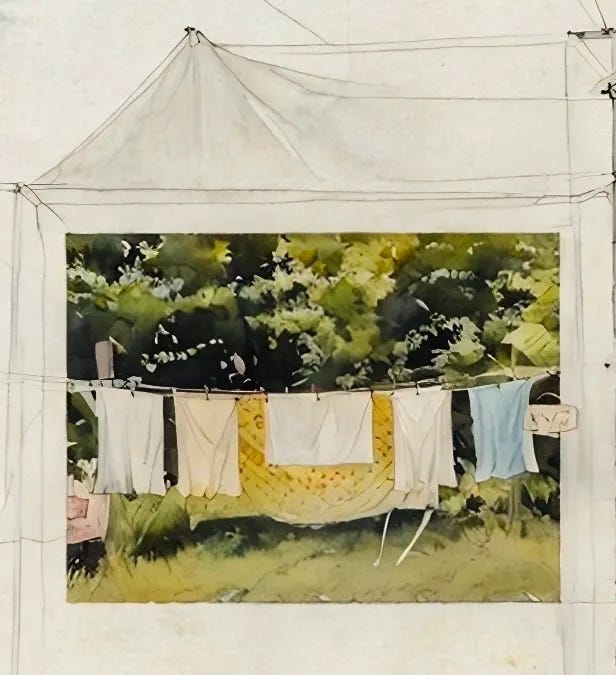
Four children. No husband. A widow, though the word rarely got used in that house. A line strung between two posts in a New England yard, and Clara went out to it every Saturday morning the way other people go grocery shopping.
That is the whole of it, really. She hung the wash.
She did it in the cold, when the pins stuck to her fingers and the sheets went stiff before they went dry, stiff as boards, stiff as something you’d have to break to fold. She did it in the wind, which took the corners of things and snapped them like an argument. She did not stop doing it. Widowhood does not come with a clause excusing you from laundry, and if anyone whispered about a woman alone with four children and no man’s name to answer for her, she did not answer them either.
She had sheets to hang.
Inside, whatever she carried, she carried alone. Outside, on the line, none of it showed. That was the arrangement she made with the day: the wind got the sheets, and she kept the rest.
Later there was the iron. Steam off wet cotton, the smell of it, a smell that does not have a good word in English — scorched-clean, maybe, or something like it. She pressed creases into pillowcases nobody but her would ever look at closely enough to notice, because noticing was not the point. The point was that a bed made a certain way was a house that still functioned, was children who still had somewhere clean to put their heads down, was a woman deciding, sheet by sheet, that she was not going to let the thing that happened to her become the thing that happened to them.
The sheets themselves were never ordinary. Old French linens, most of them — monogrammed in initials that weren’t hers, weren’t anyone’s she could name, picked up for pennies at estate sales the way you’d pick up anything too beautiful for the price being asked. She never explained the monograms and I never asked. It didn’t occur to either of us that loving a thing required knowing its whole provenance. She just wanted good linen and she wanted it done right, and somewhere in there I inherited the whole fetish outright — I deal in the stuff myself now, hunt down other people’s monograms in other people’s initials, and I still can’t run one through a dryer without feeling like I’ve committed a small crime against her memory.
I think of her now mostly by accident. A sheet off the line, still warm from the sun, dragged across a face — that does it. There is nothing else quite like it, and no dryer has ever managed to fake it. She never called it love. I don’t think the word would have occurred to her, or if it did, she’d have found it too soft for what she was actually doing, which was harder and plainer than love usually gets credit for. I know she lived it, pin by pin, in a yard in New England, for longer than anyone should have had to.
She is gone. The line is gone too, in that yard — nobody hangs wash anymore, not really, not the way she did, as if it were liturgy and not chore. But I still do it. Every Saturday, at Hemlock House, I hang the sheets and press them — I couldn’t tell you why, except that it is the one thing I know how to do exactly the way she taught me, and doing it is how I remember her. Fabric snapping in a wind off a Vermont mountainside now instead of the water — a person working alone, refusing, in the smallest possible way, to go under.
She taught me that. Not in a lesson — she wasn’t a woman for lessons — but in the doing, over and over, until it was in my hands before it was ever in my head. It has buoyed me since, more times than I can count, in ways that had nothing to do with sheets. No matter what else was happening, there was a line, and there was wash, and there was a way to stand at it that did not require anyone’s permission to keep going.
For Clara, who taught us that strength is sometimes simply getting up and doing what needs to be done, with love woven into every fold.
Read more from The Magpie Chronicles…
The Magpie Chronicles is written by M Sebastian Araujo from a handbuilt house deep in an old growth forest, where the winters are long and the opinions are longer.
The Magpie Chronicles arrives when it has something worth saying — antiques, art, history, the occasional miracle, and whatever the world is doing at the moment. If something here found you, subscribe. The basket is always full.
Discover more from M Sebastian Araujo and subscribe here…
If you enjoyed this post, hit the ♡ to let us know.
If it gave you any thoughts, please leave a comment.
If you think others would enjoy it, hit re-stack or share:
If you’d like to read more:
And if you’d like to help create more Juke, upgrade to a paid subscription (same button above). Otherwise, you can always help with a one-time donation via Paypal or Venmo.
 | A guest post by
|
Thank you, Sebastian. I cannot tell you how much I needed this right now. ❤️