
Otherwise
Knowing how few hours there can be in a lifetime…

“I got out of bed
on two strong legs.
It might have been
otherwise...”
I never really loved Jane Kenyon’s poem “Otherwise.” I love other poems more. The language of “Otherwise” is so quiet. It’s almost too quiet. It’s everyday language—cereal, bed, candlesticks. It doesn’t arrest me while I read it. But then, sometimes a poem becomes a part of your mind, regardless of whether you want it there. Despite not loving it, I think of “Otherwise” often. I hear her phrase “it could have been otherwise” reciting itself inside me at surprising moments.
I ate
cereal, sweet
milk, ripe, flawless
peach. It might
have been otherwise.
I took the dog uphill
to the birch wood…
Like Jane, I have my bowl of cereal. I have the dog to walk. The laundry in the hamper. It could all have been otherwise.
Maybe the poem lingers because I know it was published after her death. It was likely written while she was sick. I’ve read her husband Donald Hall’s book of poems about that period of time—his wife’s early, terrifying, beautiful death from leukemia. He made it beautiful, somehow. Donald made her death into art. And so did she, really, with “Otherwise” and the other poems in that final collection. She was a poet married to a poet and so her death is still here, even now, twenty years later. It’s still there in the books.
“They talked about their
adventures—driving through England
when they first married,
and excursions to China and India.
also they remembered
ordinary days—pond summers, working
on poems together,
walking the dog, reading Chekhov
aloud. When he praised
thousands of afternoon assignations
that carried them into
bliss and repose on this painted bed,
Jane burst into tears
and cried, ‘No more fucking. No more fucking!’”–Donald Hall
I can’t get over how alive she is. The painted bed; the coarse, honest language of a living woman. I opened my copy of Donald Hall’s selected poems and I found her alive, still there in the pages. And isn’t that kind of a miracle? I am there, standing in the doorway of his memory. I am allowed to be present with her, sitting together on the bed.
To call something a miracle, to say that this poem, this life, is special—it’s simply to say the same thing over and over again. It’s what Jane said. It could have been otherwise. Everything, anything, could be otherwise. Will certainly be otherwise. But here we are. We have this moment. This bowl of cereal.
I began to think of this essay in the middle of a heat wave. Over a hundred degrees in New York at the start of the Fourth of July weekend. The city filled up with French and Paraguayan World Cup fans, who met each other in New Jersey that Sunday. The East River was like a kid’s bathtub, masts and more masts of tall ships, sailing in celebration of the country’s 250th anniversary. The Navy was arriving for Fleet Week. Uptown, the cops were diverting traffic around Madison Square Garden for Taylor Swift’s wedding.
I was indoors that morning, dreaming of a drive out of the city. I couldn’t stop thinking about a book I’d read by Ian McEwan, called What Can We Know. It’s another one that’s become lodged in my mind. On one level, it’s just another book written for English majors—a book about an English professor and his quixotic pursuit of a lost work of literature. The professor is like any other professor in any academic fiction you’ve read: he’s poorly paid, inept with his friends, fumbling at love. The book could have been any number of less memorable campus novels, except that, in this case, the professor character is living and teaching literature in the year 2119. He’s seeking a lost poem written by a British poet, Francis Blundy, in 2014—a year which is, for the professor, an almost unimaginable before-time. In the intervening century between 2014 and 2119, the world has gone through what they call “The Derangement” and “The Inundation,” during which time the seas rose and overtook most of the world’s dry land. A series of regional squabbles developed into a pingpong of escalating nuclear attacks. Eventually, the human population (halved by this point) retreated into its crippled nations, nurturing and rebuilding what it could.
Which all sounds very dramatic, but the book wasn’t dramatic. By 2119, the upheaval has finished heaving, and people are living a recognizable existence again—even if they need to take a ferry to get from one town to the next. Much of the past is still recorded. The libraries are situated on high ground. Universities continue, and research continues. What I found fascinating was less the book’s description of life in 2119, (which was wisely left vague beyond the pertinent details,) and more the lyricism of McEwan’s professor on the subject of the distant past—my own present tense. The last golden days of the early 21st century. Those passages are what I keep remembering:
“Simply writing those place names - magical Swindon! - brings on a sweet melancholy. Oh, to have been there, when strawberries and oranges came in winter as a matter of course. Even to set down a date - 2010! To have been alive then in those resourceful raucous times, when the sea stood off at a respectful distance, when you could walk in any direction as far as you liked and keep your feet dry. When you might see and hear the real Francis Blundy in proud Huddersfield - 1994, in the town hall…”
“The Blundys and their guests lived in what we would regard as a paradise. There were more flowers, trees, insects, birds and mammals in the wild, though all were beginning to vanish. The wines the Blundys’ visitors drank were superior to ours, their food was certainly more delicious and varied and came from all over the world. The air they breathed was purer and less radioactive. Their medical services, though a cause of constant complaint, were better resourced and organised. They could have travelled from the Barn in any direction for hours on dry land…”
The character’s love interest, Rose, accuses him of having “distorted notions of the period.” She thinks that he exaggerates “the vitality and beauty of the past and ignore[s] its squalor and cruelty and morbid greed.”
“What, she demanded, of the self-serving short-sightedness or plain folly or mendacity or viciousness of political leaders - take your pick - and the quiescence or craven idiocy or terror of their populations? What of the people’s careless love of autocrats? How could we overlook or forgive the desolation those times bequeathed, the poisons they left in the oceans, the forests they stole, the soils and rivers they ruined and the Derangement they acknowledged but would not prevent? It was all scorched earth, all blithe contempt for the generations to follow. The world I hankered after was a privileged corner - Gloucestershire! The big world beyond was sinking. How could I go on about the James Webb telescope?”
But he can’t help himself. And I couldn’t either, reading the book. I couldn’t stop myself from loving these admittedly barbaric times.
“I treasured the crazy music and fads and troubled movies and serious science, serious history, serious biography. My list was long - the suspension bridges, the orchestras, street parties and a thousand forms of music festivals, and people’s gardening and cooking, their need for holidays, extreme sports, historical enactments, gay-pride carnivals, the risks they took with AI, the sense of humour, the safe airplanes, the passion for pointless sports. A hundred thousand at a football match! An astronaut playing golf on the moon! Did she know about the cheese-rolling competitions? Four billion people watching the–
‘Enough, Tom.’”
I put down McEwan’s book with an odd kind of exhilaration. I opened my refrigerator and was amazed. Look, there are the strawberries! It’s all still here! The feeling has kept at me ever since, even after picking up and laying down a handful of other books. When I’m out in the evening and I hear a bird singing at the river, I think of the book again, and my heart breaks at the thought that I am able to hear this bird. Someday, no one will hear that sound again. Even if that species of bird never dies out, that particular bird will be long gone, and then I’ll be gone too. I won’t be here anymore to do anything, much less stop and listen to a bird. And I won’t ever have known precisely what kind of bird this one was, or even which tree it was perched in when I heard it.
One day, everything will be otherwise—for me, for the bird, for the river. One day, and this day could be tomorrow, we’ll be gone. If we’re lucky, we’ll be words on a page, and someone will read about us and they’ll think it was an amazing thing to be standing in this city on an evening in July as the sun fell behind Jersey City for the evening. Somewhere uptown, just at that moment, Taylor Swift was changing into another dress. And all across the city, people were throwing their sweaty clothes in their hampers and taking a quick shower before they met their dates. From restaurant to restaurant, the waiters were unwrapping the piles of freshly laundered napkins. Out on the sidewalk sheds, they dotted the tables with battery-powered candles or tiny, elegant lamps.
I nearly wrote “the Covid Cabanas,” but I realize we’ve already lost that phrase, just in the past few years. It’s frightening how quickly the present tense falls into memory…
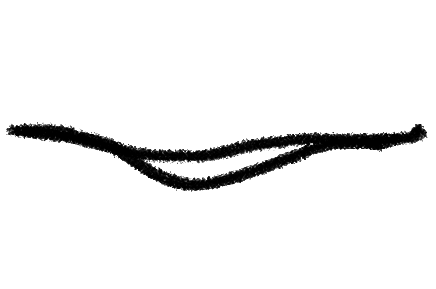
We’ve been planning a trip to South Dakota for the end of the month. We’re watching the smoke maps and the weather forecasts, which are predicting hundred degree temperatures in the days before we arrive. A hundred degrees in the Black Hills seems impossible to me. The trees will be like matchsticks.
When I was a kid, in the forest, we never needed air conditioning. In the high summer, for a week or two, it would get hot enough that we closed the curtains and spent the midday hours in the basement, which stayed cool like a cave. But then, each evening, we would open all the windows again and the breeze was so sweet, it was impossible to stay inside. Even now, if I try to think of my happiest moment, I think of a summer evening at that house, running up the grass from the forest toward the yard. The way the grass felt so cool and soft after the pebbles and pine needles. I was always barefoot then. And the way the air felt. That purple late-evening summer sky.
Time had no meaning in the summer. I remember standing on the porch at night, watching my mother work in the garden. Her shadow moving in and out of the light cast by her little lantern. I wasn’t thinking of anything then, not the next day or the next years. I was only happy. Everyone I loved was there.
I had that forest before the logging trucks came, back in the days when we could follow the deer paths unerringly to the edge of the bluff and look down on the clean, green meadow below. The highway in the distance. That was my favorite view, out across that meadow into the hills, back in those years before the wildfires burned the tall pines down to the rock. Before the scrubby new trees began to grow back in their place. I knew the creek below when it was still wide and the highway was skinny, clinging like a pen line to the sharp curves in Boulder Canyon. Later, the road was wide and the creek went dry, and in the dry years, the pine beetles came for the trees. But all that was later, after the deer trails were all scrambled and tree-fallen, so that I could only find my way to the edge of the bluff by guessing. And then still later, when the meadow below was run all to mud by off-roaders. After the trees in the hills grew back different, scarred by yet another fire and another seven years of drought. And I never did find my old reading place by the creekside again.
But I knew magic there. That sensation doesn’t go away. I was raised in a place that smelled like pine. In the summers, I watched my parents fell trees in the woods behind our house. I sat at a safe distance as they sawed the trees into logs, then chopped down the logs into ever-narrower pieces for the winter wood stove. I was young enough and unhurried enough to really see it all happening. The first pasque flowers on the forest floor. The lupines. I find myself reaching for a sketchbook now, wanting to draw that ancient view from the bluff, a crescent of road bending along the hill, and, across the valley, the trees stretching out forever.
It looked that way once. It was a wonder. One of the many wonders.
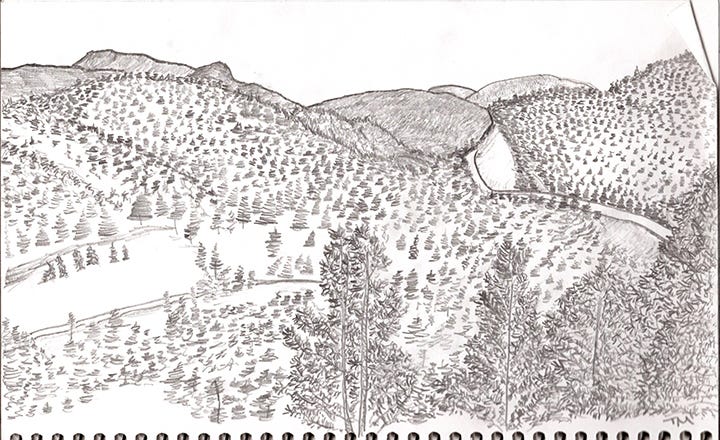
I have such a strong memory of sitting out at that bluff in the evening, watching the headlights of cars on the highway. I recall the feeling so strongly, the simultaneous love of this heartachingly beautiful place, the knowledge that the beauty I felt wouldn’t last very long—only as long as I was willing to sit, a few minutes maybe—and the most powerful longing, which was all tied up with the headlights, the flash of yellow along the trees, the way I lost each of them around the turn. That urgent adolescent mix of infatuation and sadness. Which has become, maybe, the defining feeling of life. Of being alive.
You can never quite get your fingers around it.
As I’ve been planning this trip back to South Dakota, I’ve had fits when I felt unaccountably resentful. What is it about that old place? Why does it make me feel so ill done by? It’s like the hills are withholding something. Or something was taken away. Something was meant to have stayed the same, but instead it’s all changed. Why didn’t someone hold my place for me while I was away? I know, walking down the street in Rapid City, or even Sturgis, I won’t recognize any faces. But shouldn’t there be one or two, at least, who remember me?
I guess you can’t expect it of a place, not a town, not even a small town. Not even a forest, after nearly twenty years away. The trees themselves are different, after so many of them burned away or died of disease, and new ones have grown in their place. I should stop expecting to find any of myself there. But still, I do.
Some days I think I’ve moved through my life like water. Touch, touch, touch without holding. To the grocery, on the train, to another town, a gallery, another train, through the park, through the crowds moving alongside the river. I have always moved on my own current, swimming among all the others, but rarely a part of anything. Rarely pierced by anything. Depending on the day, I can be exhilarated by my separateness (I am free!) or else I become unhappy. I feel like an alien in the world. No place to settle.
Sometimes I want to close my eyes and run my hands again through the sage I planted, far away, a long time ago. I want to rub my fingers into the leaves of the lemon balm. I can touch them again, then let them go again. I can imagine all my memories are gone; where they were is only wind.
Then sometimes I want to sit down where I am, in the dust, on the edge of the park, and let the rest of the world continue to move forward around me. I want to root down into this moment and let everything else pass by, all the people, money, opportunities, the flow of technological progress. To let loose of all the striving. To not even be interested by it. To, instead, look up to where the trees are swaying against the sky. To give in to the clouds. To put on a piece of music and fall headlong into it and stay there. To live inside a painting, inside music, inside tree bark and soft touches. And then stay there. Just stay.
I grow lazy some days, confusing the lines between the miraculous and the everyday. I forget that it’s a miracle just to be whole and to be on this earth at this time. It is a miracle to be in love. To be loved back. A miracle that we don’t disappoint each other. It’s a miracle to be given so much kindness. To be given such opportunities to be kind. To have sweet, perfect strawberries and blueberries in June and then peaches in July. To know there will be figs in the fall.
Gratitude is a kind of sadness, if you think about it. It isn’t feathered. In some ways, it’s the opposite of hope. It’s knowing where you’ve been. It’s seeing where you are. That soft evening light glinting off the taxi cabs. Knowing that you were given these gifts, and that they don’t just stick around, certainly not forever. Even in the next few moments, everything could change.
“Why were they not
contented, four months ago, because
Jane did not have
leukemia? A year hence, would he question
why he was not contented
now? Therefore he was contented.”-Donald Hall
Isn’t it extraordinary that I made it here at all? Somehow I found my way to this place, along this wide river, and I’ve met all these people I now cherish. Isn’t it something? We were all given a little time together, even if it is only a little time. Even if it’s only for a single lifetime. Knowing how few hours there can be in a lifetime… And look, now, we’ve had this rare, perfect summer evening, tree-shaded, cooled by that extraordinary breeze off the water. We may never feel that breeze again, you know, or see another barge sailing north into the interior.
We were alive today and, as Paul and I walked home from the river, we saw the fragile heads of purple columbine blooming in the tree pit between the bike path and the traffic. I should be so thankful. I should be glad for all the little, inconsequential things I’ve worried about today. The kind of things I won’t even remember in a year or more.
I have been haunted by otherwise over the years. Otherwise has been my teacher. In worse days, I survived on so much less than this. Less love, less light. I know where the empty room is, and I know I’ll stand in its doorway again. But still. Somehow, tonight, we’re here. And there is so much
Music.
and look, some flower petals have fallen from the vase.
And we have muddy doggie paws.
and an open window.
and outside, the soft, green, tree leaves.
There are people laughing below.
And there is kissing
and lamp light
and books piled by the bed.
And, in the morning, there will be coffee and
bread. And we can’t forget,
I don’t want to forget the strawberries.
Tonya Morton is, among other things, the publisher of Juke.
If you enjoyed this post, hit the ♡ to let us know.
If it gave you any thoughts, please leave a comment.
If you think others would enjoy it, hit re-stack or share:
If you’d like to read more:
And if you’d like to help create more Juke, upgrade to a paid subscription (same button above). Otherwise, you can always help with a one-time donation via Paypal or Venmo.
Thank you Tonya. A beautiful way to start this day. I too have been mesmerized by Jane Kenyon’s Otherwise, and by the lower case otherwise. How to make the feeling of the miraculous stay? We forget somehow, until we’re reminded by a piece like yours. By art.
Really beautiful, thanks. I knew Jane Kenyon’s poem, but I didn’t know about Donald Hall’s.