

I have been painting for over twenty-five years. I started with watercolors doing figurative paintings, and moved to oils when a friend said I painted in watercolors as if I were using oil paint. I figured, well then, I guess I might as well use oils. It was oil paint that moved me from figurative work to landscapes, which is where my practice has focused and where I ultimately found my voice as a painter.
Each painting has its own journey. Some paintings happen quickly, within one session en plein air, or in the studio. Larger pieces can take weeks, as time is required to allow the painting to evolve and reveal itself. With some paintings it’s smooth sailing, like the painting paints itself. Others can be a bit more troublesome, taking time to find themselves, or just for me to get out of the way. But mostly, it’s a joyful process where I learn a lot about myself and painting along the way.
This is the story of one of those journeys.
It is early May.
Over a morning latte at my local place for a morning latte I am pondering an idea for a painting. One totally different than anything I have done before. I have brought a sketch pad and my computer, I am ready to act on this idea.
I usually use a photo reference to start a painting; a photo of a place that captured my attention, made me stop and look - then look again, as my friend Damon Falke writes of places that have captured him. But today as I am looking over archived photos of Montana, and more recently Oregon, I am looking for forms within the landscapes before me. Of course form is very important in any painting. But, today I am looking more at shapes and forms within the landscape in an abstract way. I pull out my sketch pad and make a quick line drawing of what I see. I am blown away with the change in how I view the scene and how it translates into an abstraction of itself.
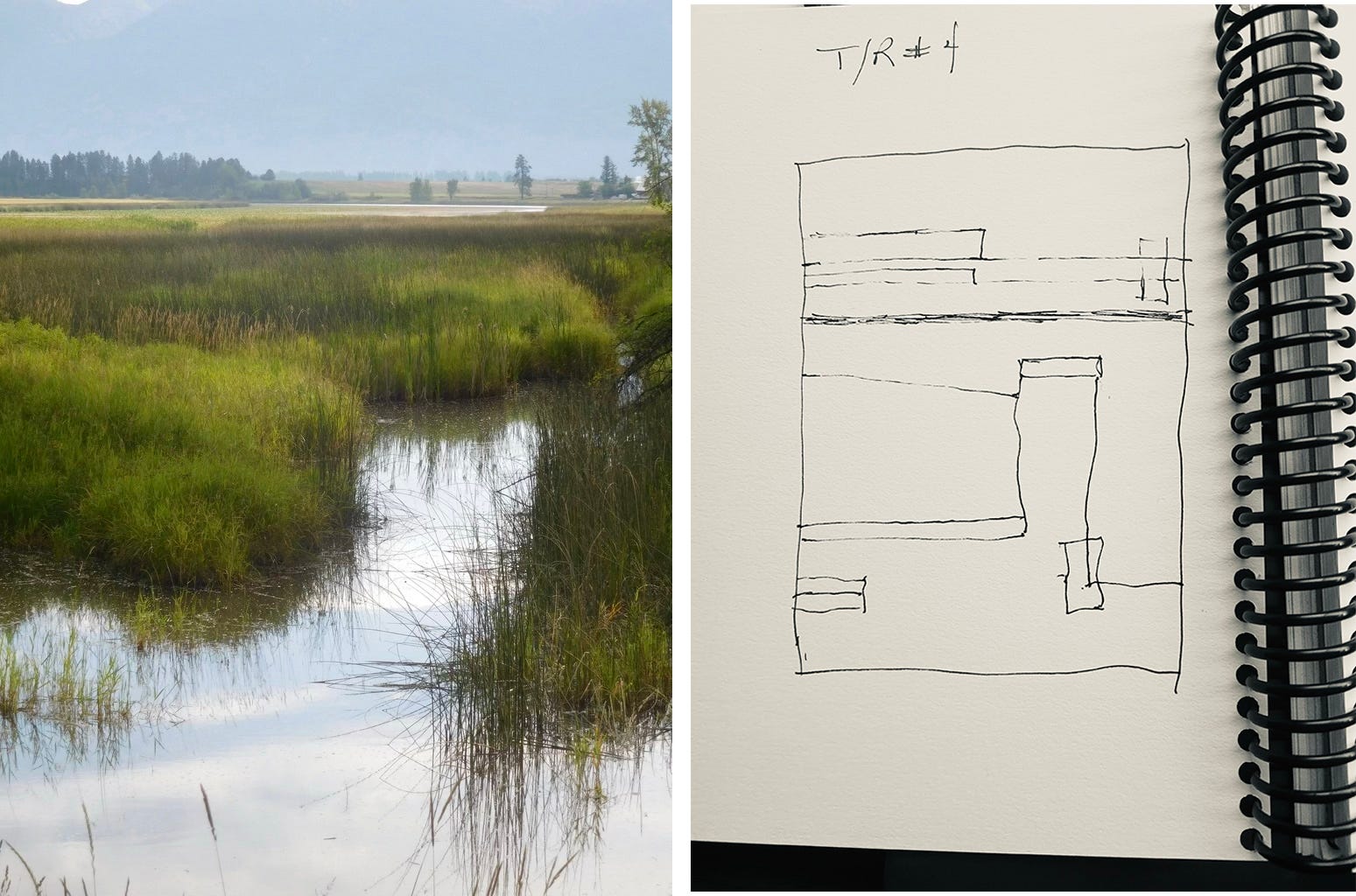
Now this could be exciting, I think. This is how I will approach the painting - as an abstraction.
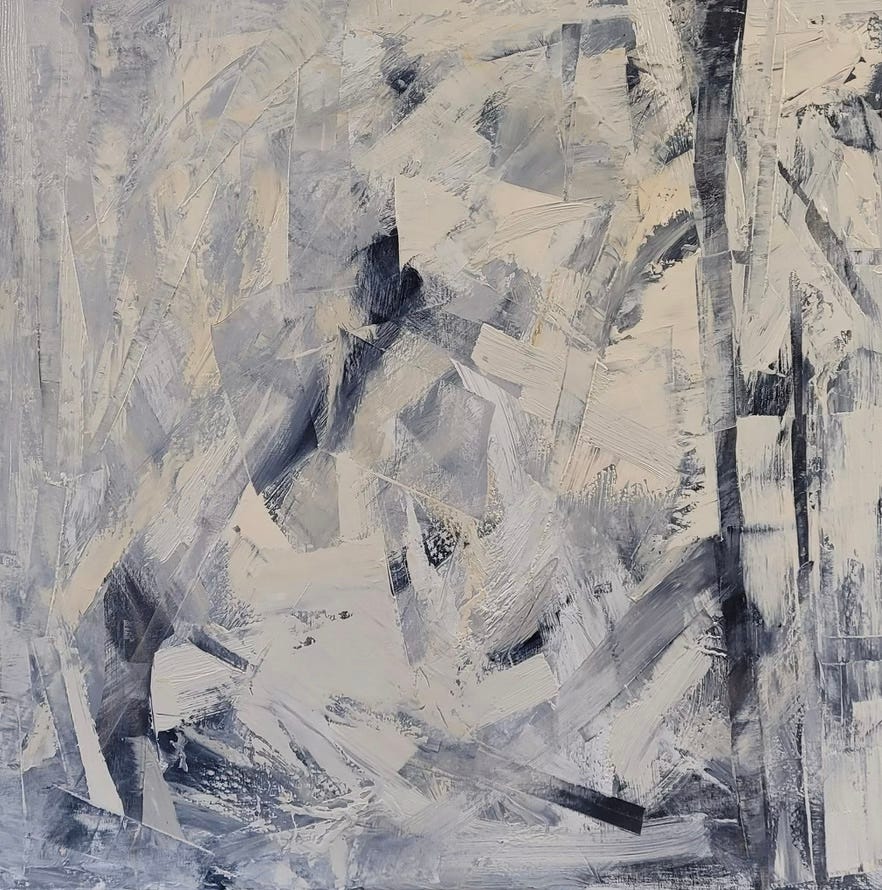
I have been wanting to pursue abstraction for some time. To approach the blank canvas purely intuitively, without a preconceived idea. The Surrealists had a word for this, automatism. In the early 20th century, the Surrealist movement adopted automatism to bypass conscious control, reason, and aesthetic rules in order to explore the subconscious in their work. I have done a few abstract pieces in the past. There are some things you do control when getting started; the size of the painting, the palette, the mood, and a general idea of composition. Once paint begins to be applied to the canvas however, all bets are off. That is when chance and emotion come into play. The physical energy of the process and the movement within the painting provides early structure. But then, intuition and spontaneity takes over, with an unconscious dialog with the work guiding you to a place where the painting ultimately finds itself.
An example from 2019:
But, for these “forms in the landscape” paintings, as I think of them, the structure is already there. It is up to me to translate these forms into something else. But what? That’s the rub.
I have always approached my painting practice as a form of self-expression. Once I mastered the basics, or at least enough to know when I messed up and what to do to fix it, I could trust muscle memory and instinct to get me to the finished painting. An early instructor, the amazing master of the Western landscape and Glacier National Park, Joe Abbrescia, stressed the importance of knowing and staying true to your “intention” for a painting. That is your North Star to guide you through the process. I try to adhere to that as much as possible, but, sometimes the painting has other ideas.
Painting is equally a practice and therapy for me. The pleasure of having painting as a creative outlet is very rewarding, as is having a means for connection to and expression of my inner self. As Megan O’Grady says in her wonderful book, How It Feels To Be Alive - Encounters with Art and Our Selves, “…the questions of impact and legacy, will always feel uncertain. There will likely be few rewards outside the pleasure of making.” So true. The making of art has changed my life in immeasurable ways.
A little context is probably needed.
I came to painting later in my life, not until my early fifties. By then I had lived a lot of lives; teenage mother, twice divorced, a career in healthcare, then in the corporate world before moving to Montana for a new life with husband number three. I was also someone who, in 1964, had suddenly and unexpectedly lost their father from a heart attack while he was on a business trip to San Francisco. He was only forty-three. I was fifteen.
I read somewhere that when a young child loses a parent they stop growing emotionally. I don’t know if that is totally true, though there is indeed some truth to it. I have also heard that children who lose a parent grow up to be high achievers with extreme resilience and independence. I would need that resilience, for within a year of losing my dad I was pregnant and married. My son was born two months before my eighteenth birthday. Losing a parent at a young age forces you to grow up quickly. As does being a mom at seventeen. I hit the daily double “grow up quickly” jackpot.
Today at almost seventy-eight I look back and wouldn’t change a thing. I have two wonderful sons, four grandchildren, and two adorable great-grandchildren. I have another wonderful extended family through my husband of thirty -six years. Whatever life was cut short on the front end, has more than been made up for on the back end. To be able to enjoy my sons, and adult grandchildren, and their children, is a gift and endless blessing. But cutting childhood short comes at a cost.
I became a master of holding my feelings in, and even worse, burying them so deeply that even I could not feel them, nor even feel. I played the part; of mother, wife, respiratory therapist, market manager, etc., but in the process lost myself. Who was this Tabby person? When I became a painter “Tabby” began to find her voice. I found that painting, for me, was more than making pretty pictures of pretty landscapes. Painting slowed things down for me. The studio became my “room of one’s own”, as Virginia Woolf advocated; a place where I could get in touch with my thoughts and express my creativity. For the first time in my life I was contemplative, not just reactive. Painting became a place for expressing something unique to me.
The French impressionist painter Edgar Degas said, “Art is not what you see, but what you make others see.” In time I found my painting voice. I was able to paint the quiet, the subtle, the places that softly whispered to me, the places that invited me to stop, and look again. In the paintings I have made over the past twenty -five years I strive to make others see the silence and calm I have always sought.
Now, back to the abstract.
I settle on the scene. A river reflection on a quiet morning, a simple composition.
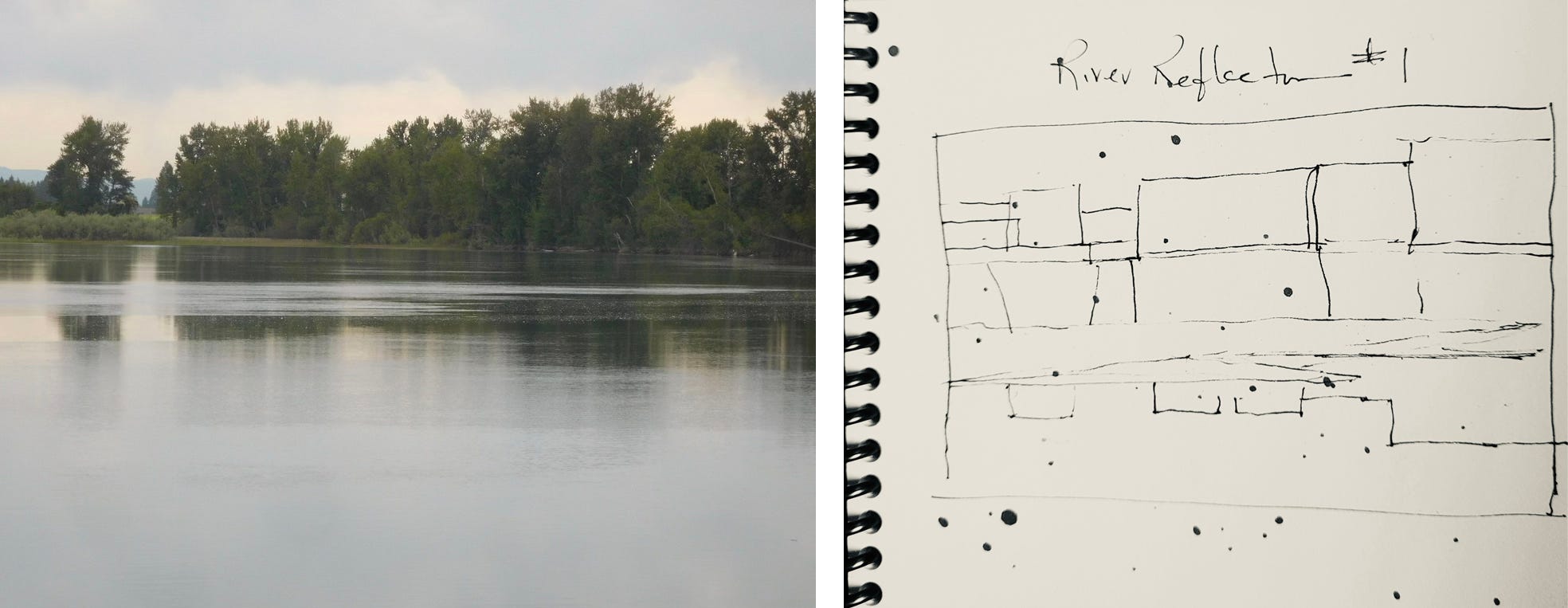
I make a quick sketch of the forms. I decide to paint over an existing 24x36 framed painting that I now find I really do not like. I mask off the floating frame, as I couldn’t figure out how to easily remove the painting from it. I sand down the panel and apply two layers of white oil gesso to prepare the surface for the new painting. I then add a layer of thinned transparent paint to tone the white surface.
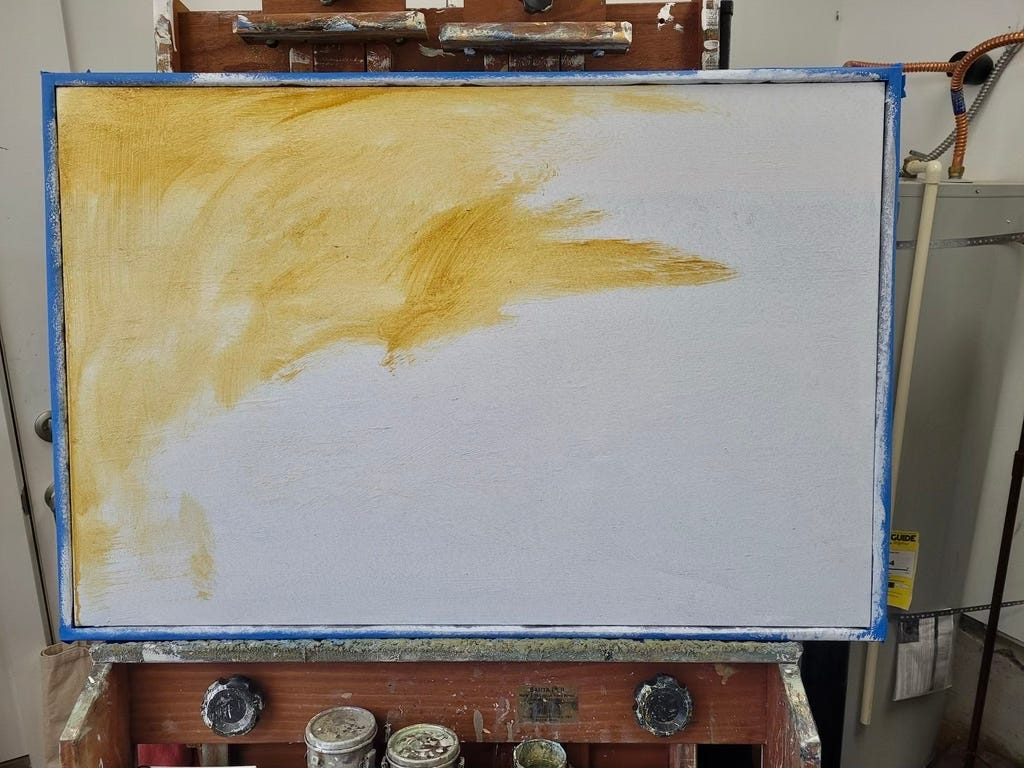
I then do my first block in:
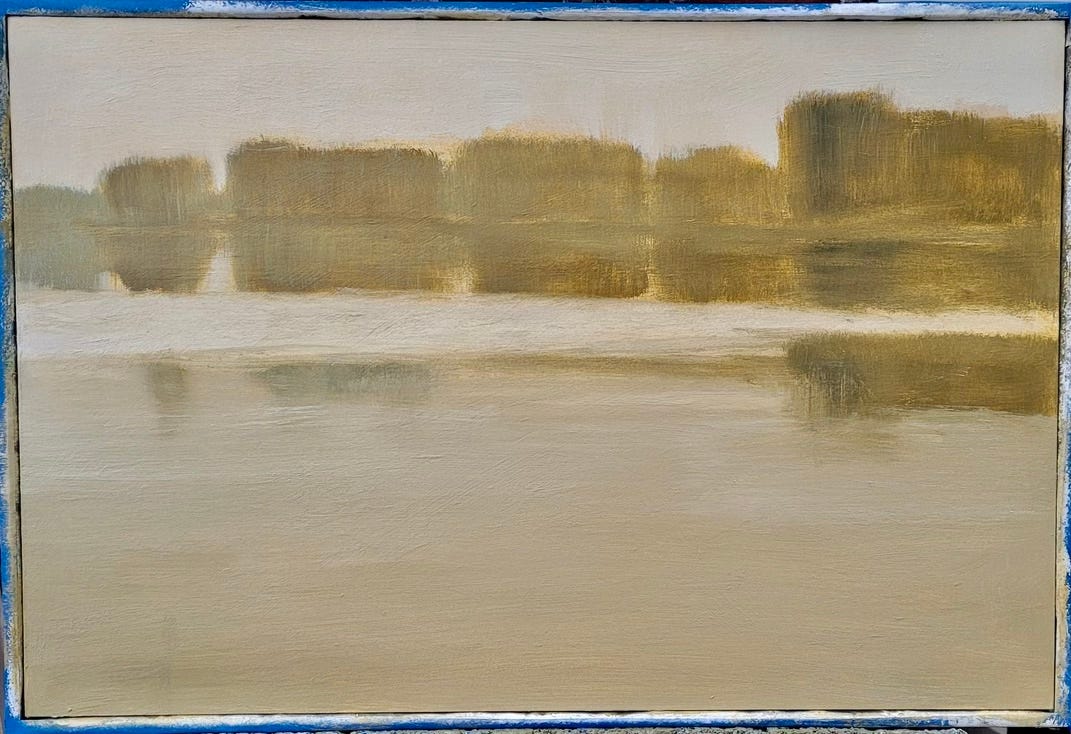
I know I am in trouble.
This is not an abstract, or at least not the abstract I envisioned. I figure, ok, it’s not what I thought I wanted but let’s see where this goes, still thinking it will in time take a more abstract form.
I start adding some value contrast to the shapes, as well as change the hue/colors in the painting.
Here is where I landed:
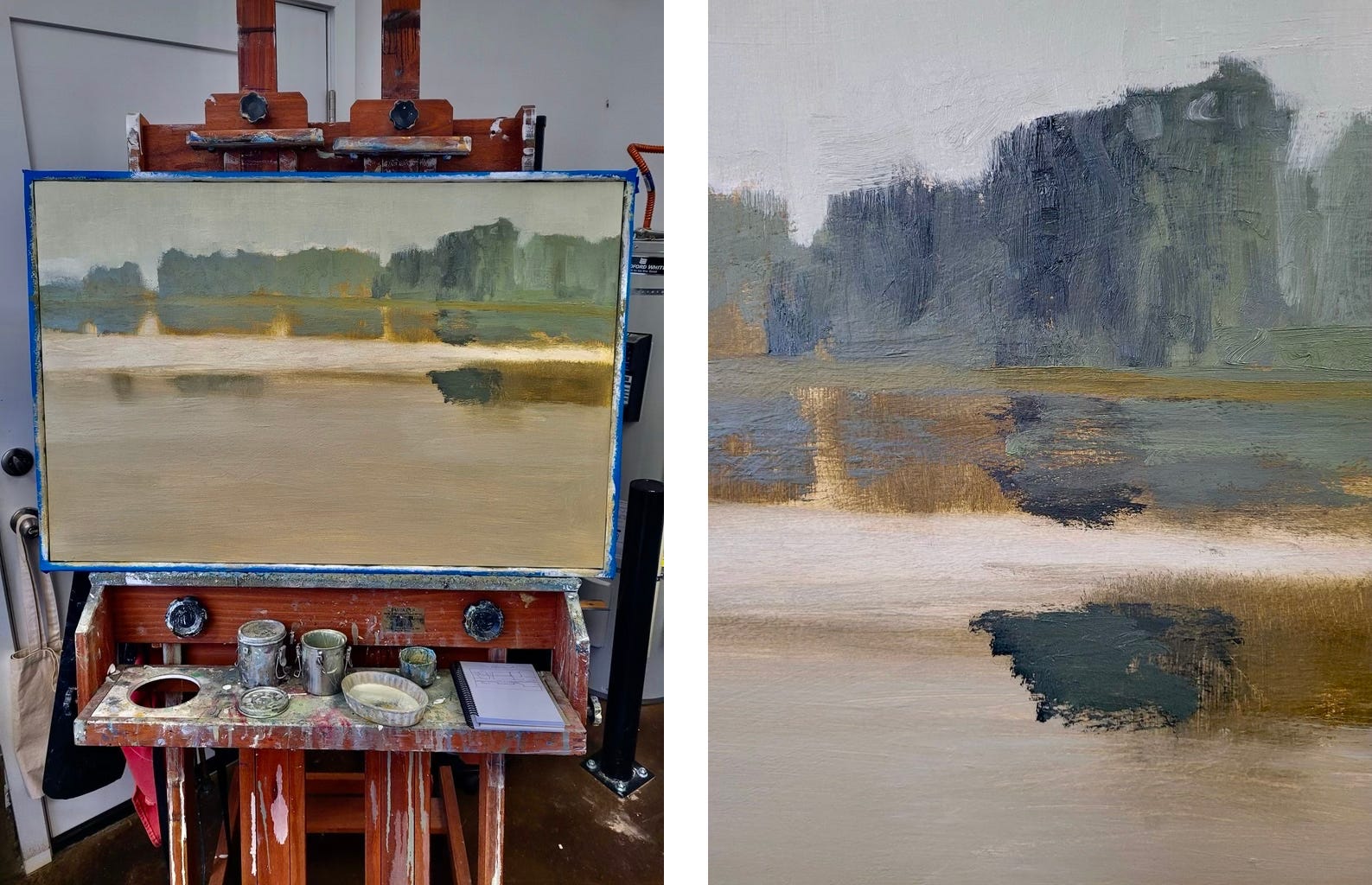
You can see from the detail on the right the impact of thicker paint and darker value in adding contrast to the painting. I do not like where it’s going.
This is when things start really going sideways. The painting is fighting me. I am being pulled away from my original plan and toward the familiar. I am in no mans land. I intuitively start adding layers, changing values. Things were happening rapidly as I intuitively made changes - so quickly I forgot to take photos. Along the way, it’s safe to say, the painting distanced itself from its abstract beginnings and found itself in a new place:
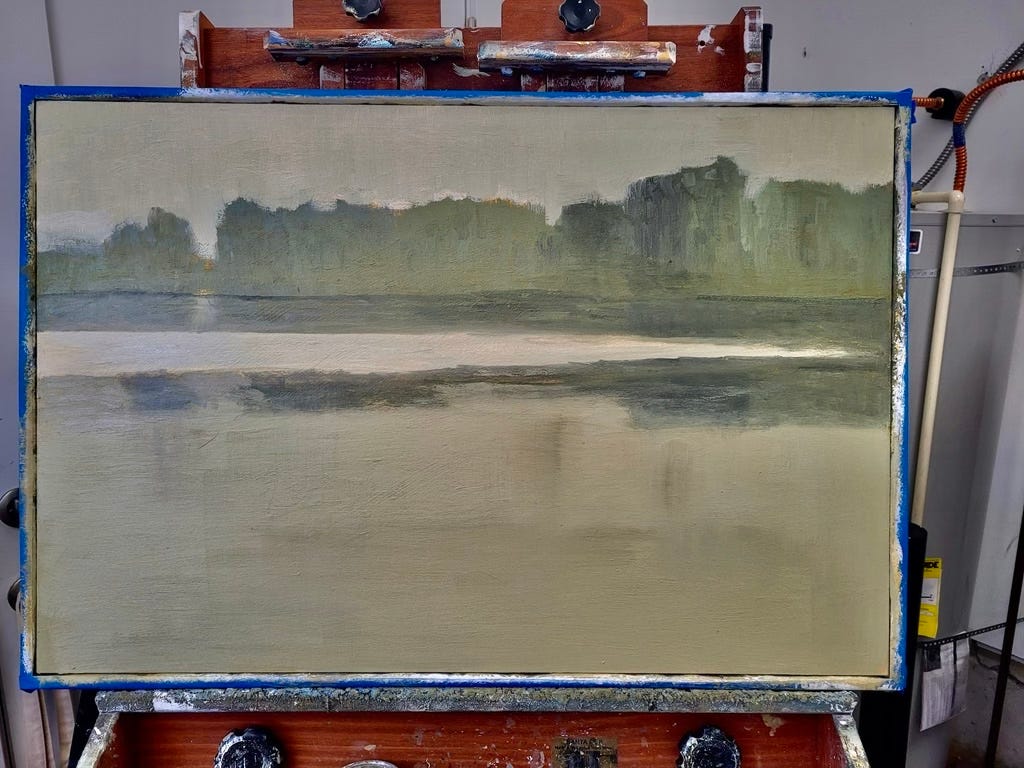
It was obvious at this point that I was not going to be staying with my original abstract intention for this painting. Perhaps because it was already in a frame, I wasn’t feeling as adventurous and free to explore something new. I realize now that I had not fully committed the time and attention necessary to fully explore what it was going to take to make my idea of “forms in the landscape” a Tabby Ivy painting - whatever that might be. I had not lived with the idea long enough to truly know what I wanted to say and how the intention for the work would take form.
My connection with a painting is very much a form of communication. I have to listen closely to what my inner voice is trying to say. And, she was telling me, at least with this painting, she was done with anything close to abstract.
When I first started to paint I took several workshops from painters I admired. I approached each workshop curious about the techniques used and the instructor’s approach to their practice. But I never went into those workshops wanting to paint like they did. I was more interested in their thinking process as they painted. How they set their intention for the painting; how they made the painting their own. The great abstract expressionist painter, Mark Rothko said, “Art doesn’t have to depict life to express it.” I wanted to know how to do that.
At the time, I was living in the Flathead Valley of Montana, very close to Glacier National Park. There were fabulous painters of the Park. While it is a vast and beautiful place, I never was drawn to paint it. I was drawn to different places, quieter places: a crevice within a hillside, a misty forest at dawn, the reflections of trees on a pond or river, or the glow of the sunset behind silhouetted hills. It is the quiet landscape that speaks to me, not the majestic nor grand; more the mood and mystery of a place.
I recently watched a Louisiana Channel interview of British painter Peter Doig, where he said, “I like the singleness of being a painter, the fact that you did it on your own…the fact that you don’t have to ask others what to do or being told what to do. It’s totally your own responsibility, a solo pursuit.” I very much relate to what he was saying. I like the solitude of being in the studio, in a place where I am separate, insulated and focused.
My studio is my sanctuary, I am not unique in feeling this way, of course. Most artists approach a painting in solitude. You can’t have anything or anyone in your head when you are in the studio. For me, I want to provide that inner child who was silenced so young a safe place to express herself. I think of her as the voice of my unconscious thoughts. I want my paintings to convey something that touches an unconscious place within the viewer. In my work, it’s the quiet that allows these whispered thoughts to be heard and seen.
For a painting of this river scene, the abstract approach was too restrictive and pushy, it spoke too loudly. I resisted it dictating to me what I had to do.
So, I embraced a new path.
I welcomed a new intention for the painting, turning away from the original abstract approach. I followed the voice steering me into the emotion and feel of the scene I saw evolving before me. This intuitive approach to my work allows me to be sensitive to what I want to say in the final painting. In this case it was all about the reflection in the water, the gentle touch of the wind on its surface, the quiet of the scene. This is what stopped me to take this photo on that quiet morning by the river that made me look, and look again.
I gave the painting a few days to rest, and to put some distance between us. We both needed a break. After a week or so I returned with a new focus. Gone was the combative energy, where the painting and I were fighting each other. I knew what I needed to do. Layers and texture were added, the palette changed, silence entered into the work. It became more the painting I had envisioned that day when I stopped along the river. I had trusted that inner voice, and gotten myself out of the way. The painting became the painting it should be. I was able to make what I wanted others to see.
So, what happened to that abstract painting of forms in the landscape?
It is still out there, or more specifically in there, within me. I will let it be for a while, let it play around in my subconscious. It will find its voice eventually, and when it does I will be ready to let her sing.
But for now….
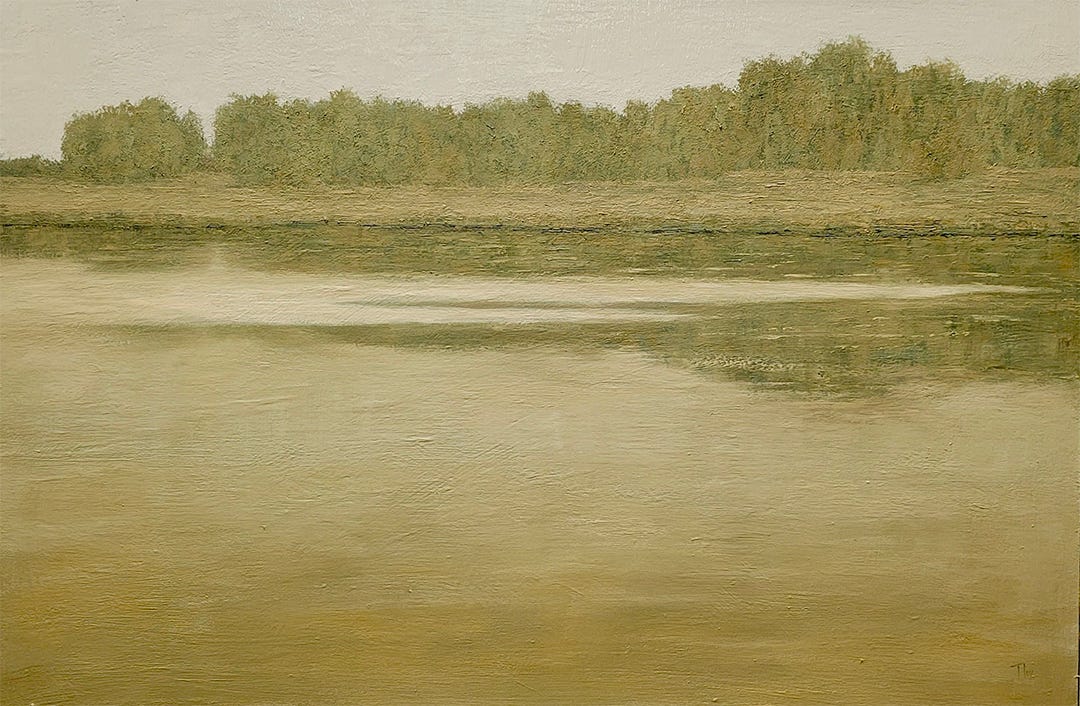
“This is what I saw, and it meant something to me; it mattered that I was here. This is how it feels to be alive.”
-Megan O’Grady
How It Feels to Be Alive, Encounters With Art and Our Selves
After over thirty years in Montana, contemporary painter Tabby Ivy now lives and works in Carlton, Oregon. Learn more about her painting practice and Between Artists, Life in Paintings and Prose and Stops Along the Way, her two books with Damon Falke, at www.tabbyivy.com.
If you enjoyed this post, hit the ♡ to let us know.
If it gave you any thoughts, please leave a comment.
If you think others would enjoy it, hit re-stack or share:
If you’d like to read more:
And if you’d like to help create more Juke, upgrade to a paid subscription (same button above). Otherwise, you can always help with a one-time donation via Paypal or Venmo.
Vibing with the idea of setting out to do something and finding yourself somewhere else. There's still room for the something: but it's not yet time.
Tabby Ivy, I enjoyed your discovery of life at its best. Concering your paintings, I have truly fallen into various flashes of depth and light and especially consolidation of your style. The gift of the strokes, sheer and shivering layers below the rest, as if somehow consolidation shades the expressions like a final curtai. The last few strokes of oil and brush inact the completeion of the scene. I enjoy the active sense of scenery discovered and fulfilled. You always give off the sense of glory and love you have for the stroke itself. A few times, I have enjoyed some fun in the hide and seek finishes that play with the work. Thank you for allowing us to reflect on the beauty of your sharing your work. The smokey greens rendering aspects of a dream. With gratitude, Constance.